Understanding Rice Polishing Ratio (Seimaibuai)
What does 'Seimaibuai 60%' on a sake label mean? Learn how rice polishing affects sake flavor, why more polishing isn't always better, and how to use this number when choosing sake.
Understanding Rice Polishing: How Numbers Change Flavor
Look at any sake label and you’ll see terms like “Seimaibuai 60%” or “Rice Polishing Ratio 50%.” You sense that smaller numbers probably mean something premium, but what does it actually mean?
This guide explains how rice polishing works and why it matters for sake flavor. Understanding this gives you one more tool for choosing your next bottle.
The Basics
It’s the Percentage That Remains
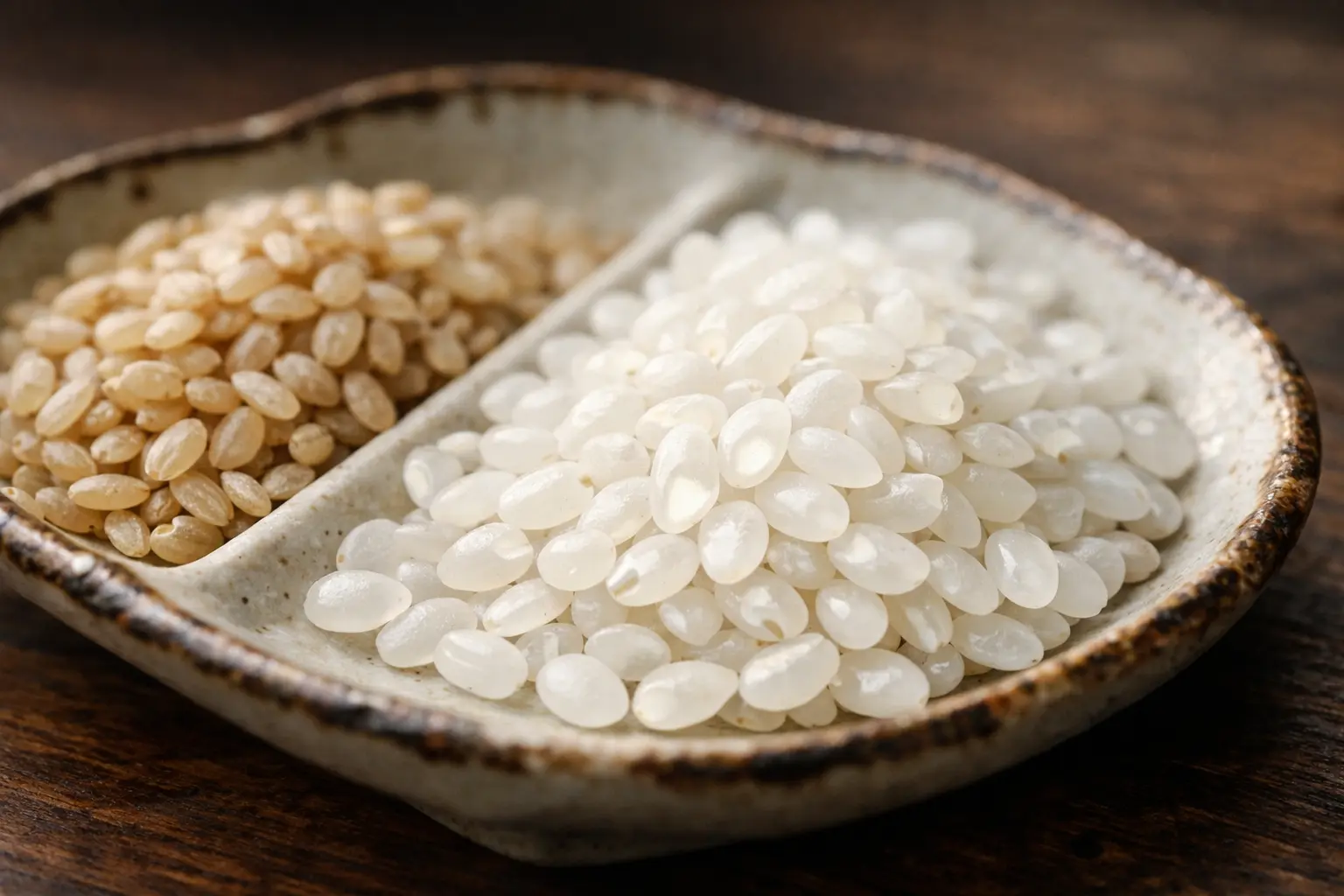
Seimaibuai (rice polishing ratio) indicates what percentage of the original rice grain remains after milling.
At 60% seimaibuai, the outer 40% has been milled away, leaving 60%. At 50%, half the grain is gone. At 35%, a remarkable 65% has been removed.
So smaller numbers mean more polishing. And more polishing means more labor and raw material costs, which typically translates to higher prices.
Compared to Table Rice
The white rice we eat daily is also polished from brown rice, but only to about 90%—just the outer bran layer removed.
Sake brewing takes this to extremes. Daiginjo commonly polishes to 50% or below. Some breweries push to 23% or even 7%. At that point, you’re using essentially just the grain’s core.
Why Polish So Much?
The Outer Layers Cause Off-Flavors
Understanding rice structure explains the reasoning.
The outer portions of a rice grain contain higher concentrations of fats and proteins. While nutritious for eating, these components create unwanted heaviness and off-flavors in sake.
The grain’s center contains the “shinpaku”—a starchy core. This starch is what koji converts to sugar, which yeast then ferments into alcohol. It’s the heart of sake.
Remove the outer layers to isolate the shinpaku, and you can produce cleaner, more refined sake. That’s the basic logic of high polishing.
The Ginjo Aroma Connection
Highly polished sake has another characteristic: the gorgeous “ginjo-ka” (ginjo aroma).
When highly polished rice ferments slowly at low temperatures, fruity aromatics reminiscent of apple, banana, or melon emerge more readily. This defines ginjo and daiginjo styles.
With fewer interfering compounds, delicate aromas stand out. The effort of polishing pays off in fragrance.
Polishing Ratios and Sake Categories
Japan’s “tokutei meishoshu” (special designation sake) categories are defined partly by polishing ratio:
| Category | Polishing Ratio | Character |
|---|---|---|
| Futsushu (regular) | No requirement | Everyday drinking |
| Honjozo | 70% or less | Clean, easy-drinking |
| Ginjo | 60% or less | Fruity aromatics |
| Daiginjo | 50% or less | Most refined and fragrant |
Junmai versions follow the same pattern: Junmai Ginjo requires 60% or less, Junmai Daiginjo requires 50% or less.
Interestingly, plain Junmai has no polishing requirement. Whether 70% or 80%, if it’s made with only rice, koji, and water, it qualifies as Junmai.
Does More Polishing Mean Better Sake?
The Polishing Ratio Myth
Here’s something important to understand.
Lower polishing ratios don’t automatically mean “better” sake.
Yes, highly polished sake tends toward delicate, refined flavors. But “fewer off-flavors” doesn’t necessarily equal “more delicious.”
The more you polish, the more you lose the rice’s inherent umami and character. Some find ultra-polished sake too clean, even bland.
The Low-Polish Revival
Recently, more breweries are deliberately using higher polishing ratios—80% or even 90%—to showcase rice’s full flavor potential.
Old-style “less polished” sake can have substantial body with rich sweetness and umami. Warmed, these qualities intensify—perfect for cold nights.
If high-polish sake is a “delicate beauty,” low-polish sake is a “powerful warrior.” Which you prefer is purely personal.
Polishing and Price
Why High-Polish Costs More
Expensive daiginjo has clear reasons behind its price.
First, milling time. Reaching 50% polishing typically takes 50-60 hours in standard equipment. Getting to 35% can exceed 100 hours. That’s continuous machine operation, electricity, and labor.
Second, material loss. Polish 100kg of brown rice to 50%, and you have 50kg of usable rice. The rest becomes bran for other uses. You need twice the rice for the same amount of sake.
So daiginjo is expensive. That cost returns as flavor and aroma.
Price Doesn’t Equal Satisfaction
That said, expensive sake isn’t automatically best for you.
A $15 Junmai might suit your palate better than a $50 Daiginjo. Don’t judge by polishing numbers alone—explore your preferences.
Think of it as “this number suggests this style” rather than “smaller numbers mean better sake.”
Reading Polishing Ratios
What to Look For
Most sake labels display polishing ratio.
“Seimaibuai 60%” indicates ginjo-class polishing. “50%” is daiginjo territory. “70%” suggests honjozo or junmai class.
This number alone gives you a reasonable flavor prediction:
- 50% or below: Delicate, elegant, aromatic
- Around 60%: Balanced, food-friendly
- 70% or above: Rich rice flavor, good for warming
Of course, these are tendencies. Same polishing ratio, different brewery and technique—different result.
When It’s Not Listed
Some sake omits polishing ratio. Regular sake has no requirement, so it’s often left off. Some breweries deliberately omit it, signaling “don’t judge by numbers.”
Unlisted doesn’t mean inferior. It might mean the brewery wants flavor to speak for itself.
Summary
Rice polishing ratio is one valuable clue for sake selection.
Lower numbers trend toward delicate and clean; higher numbers tend to retain more rice character. But “lower is better” oversimplifies reality.
Consider whether you want elegant aromatics or substantial umami. Think about the occasion and food pairing. Use polishing ratio as a guide, not a rule.
Understanding what the numbers mean makes sake selection more enjoyable.
Want to learn more about sake categories? See Understanding Junmai, Ginjo, and Daiginjo.