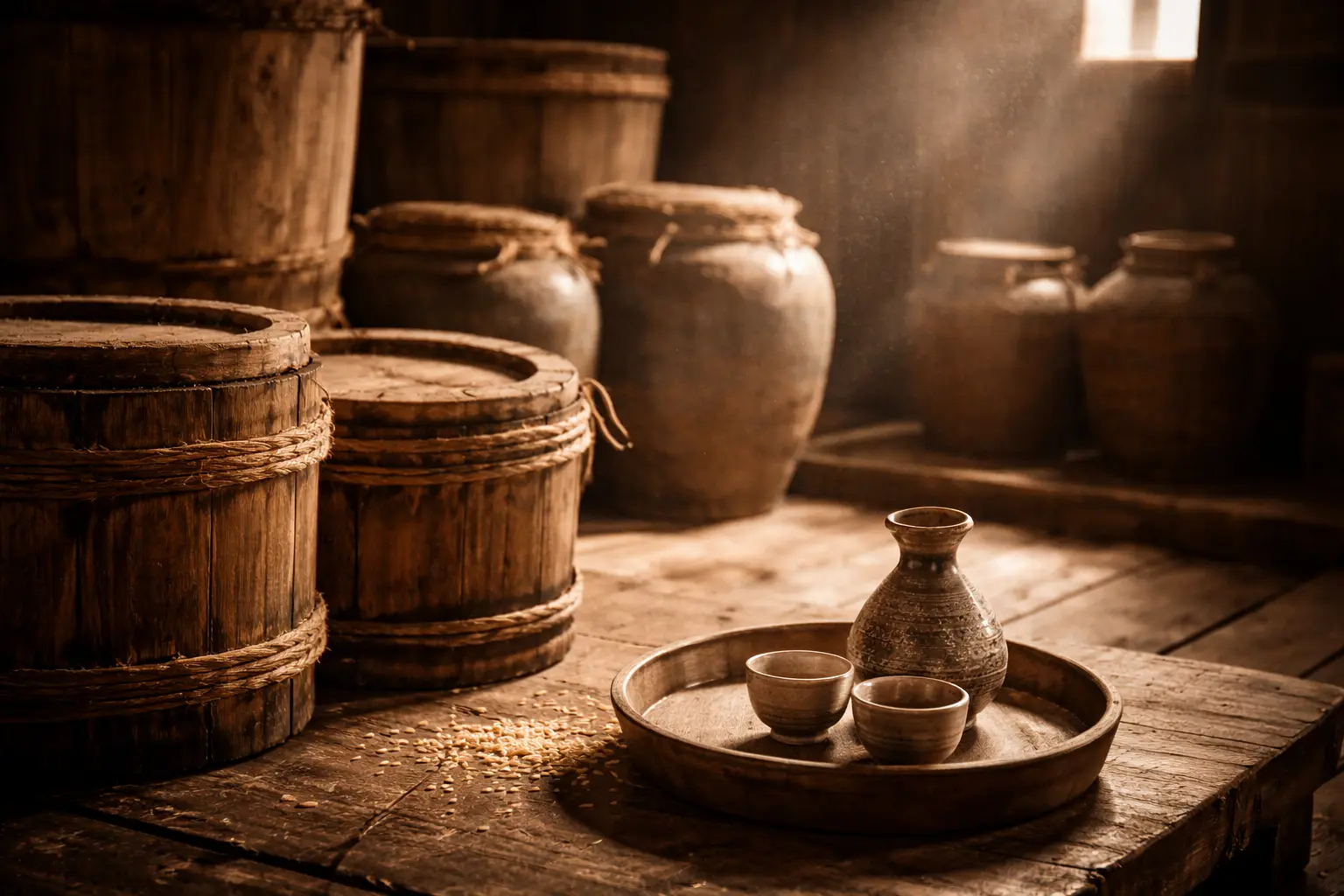
The History of Sake: From Ancient Times to Today
When and how did sake originate? Trace over 2,000 years of history, from primitive kuchikami-zake to modern craft sake.
The History of Sake: A 2,000-Year Story
Where should the history of sake begin?
The Yayoi period when rice cultivation arrived? The Nara period when koji-based brewing was established? Or the Edo period when common people could finally drink it freely?
Over more than 2,000 years, sake has transformed many times. Let’s trace that evolution.
The First Sake: Kuchikami-zake
With Rice Cultivation
Rice cultivation reached the Japanese archipelago around the 10th century BCE. Where there’s rice, there’s potential for sake. By the Yayoi period, some form of rice-based alcohol was likely being made.
The most primitive method was “kuchikami-zake”—chewing rice, using enzymes in saliva to convert starch to sugar, then fermenting with wild yeast.
You may have seen this depicted in film. Though how common this practice actually was remains unclear.
Sake in Ancient Texts
The Kojiki and Nihon Shoki, compiled in the 8th century, contain numerous references to sake.
The story of Susanoo defeating Yamata no Orochi by getting it drunk. Sake as offerings to the gods. These accounts show that sake held cultural importance at least by the Nara period.
The Discovery of Koji: A Technological Revolution
From the Continent
What dramatically transformed sake brewing was koji technology.
Using koji mold from China meant rice starch could be converted to sugar without chewing. This opened the path to large-scale production.
When exactly koji reached Japan is debated, but by the Nara period at latest, koji-based brewing was practiced.
Temples and Sake
From the Heian through Kamakura periods, temples became centers of sake production.
These “soboshu” (monk’s sake) were the premium products of their time. Temples had the knowledge and funds to research and improve brewing techniques.
Shoryaku-ji in Nara is credited with developing “morohaku” brewing—using polished rice for both koji and main mash. This became the prototype for junmai sake.
Edo Period: Sake for the People
The Rise of Itami and Nada
During the Edo period, sake brewing developed into an industry.
Itami and Nada in Hyogo became famous brewing regions. Nada’s hard “miyamizu” water produced dry sake that suited Edo tastes.
“Kudari-zake” shipped to Edo by sea barrel became the branded sake of the era—considered superior to locally made alternatives.
Technical Advances
Several important techniques were established in this era.
Hi-ire (Pasteurization) About 300 years before Pasteur, Japanese brewers discovered low-temperature pasteurization. This stabilized sake quality and enabled long-distance transport.
Sandan-jikomi (Three-Stage Brewing) Rather than adding all ingredients at once, brewing in three stages. This stabilizes fermentation and prevents bacterial contamination. The method remains standard today.
Improved Rice Polishing Water-wheel polishing spread, allowing sake to be made from whiter rice.
Meiji to Showa: Modernization’s Light and Shadow
Science Arrives
The Meiji government promoted sake modernization.
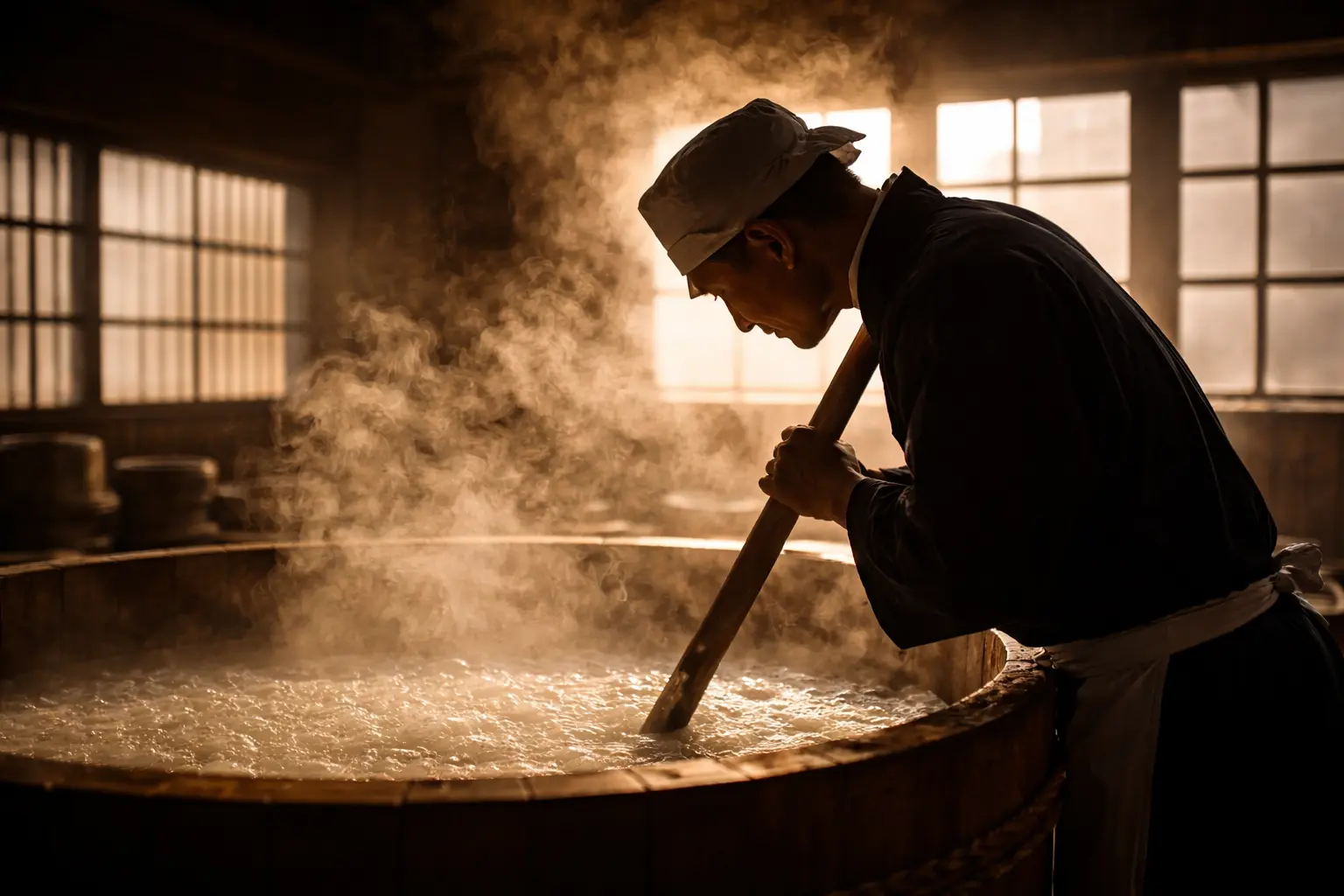
In 1904, the National Research Institute of Brewing was established, beginning scientific study. Pure-culture yeasts were developed, improving quality and consistency.
The distribution of “kyokai” yeasts—superior strains—raised sake quality nationwide.
Wartime Degradation
During World War II, rice was rationed, affecting sake production.
To make more sake from limited rice, heavily alcohol-added “sanbai-zojo-shu” (triple-increased sake) became common. Volume increased, but quality suffered.
The image of sake causing bad hangovers largely stems from this era’s triple-increased sake.
The Grade System
The grade system introduced in 1943 lasted until 1992.
Tokkyū (special grade) was highest, nikyū (second grade) lowest. However, grades partly depended on whether breweries submitted to quality testing, so excellent sake sometimes remained classified as second grade.
Heisei to Reiwa: Revival and Challenge
The Ginjo Boom
From the late 1980s, ginjo sake began attracting attention.
Fruity aromas and delicate flavors. People rediscovered that sake could taste this good. Combined with the jizake (local sake) boom, regional breweries gained spotlight.
The Tokutei Meishoshu System
In 1990, the grade system was replaced by tokutei meishoshu (special designation sake) classifications.
Junmai, ginjo, daiginjo—categories based on ingredients and methods. This helped consumers better understand sake characteristics.
Brewery Decline and Rebirth
From over 3,000 breweries in the 1970s, numbers dropped to around 1,400 by the 2020s.
Yet new entries and dormant brewery revivals are occurring. Young generations taking over family businesses and creating new-style sake is increasingly active.
Global Expansion
In the 21st century, sake exports have surged.
“Sake” is becoming a globally understood word. New York, London, Paris—sake is enjoyed in cities worldwide.
Some are establishing breweries overseas. Perhaps we’re entering an era where the very definition of sake is being questioned.
What History Teaches
Sake has over 2,000 years of history.
During that time, methods changed, drinkers changed. From offerings to gods, to aristocratic drinks, to common enjoyment, to global beverage.
What hasn’t changed: the basics of rice, water, and koji. And people striving to make better sake.
Every glass we drink today contains that long history.
Learn more about sake production in How Sake is Made or What is Koji.