The History of Sake: From Ancient Times to Today
When and how did sake originate? Trace over 2,000 years of history, from primitive kuchikami-zake to modern craft sake.
The History of Sake: A 2,000-Year Story
Two thousand years of time are settled into a single cup of sake.
From the Yayoi villager who chewed rice and spat it into a jar, to the modern bartender pouring daiginjo in a New York bar, an almost unimaginable amount of trial and error lies between. Here, let’s follow that long road in the order it unfolded. The dates and names are, in a sense, signposts—markers to follow as we trace how this drink kept changing its shape.
It Began With Rice—From Yayoi to Nara
The story starts with the arrival of rice farming. Wet-rice cultivation reached the Japanese archipelago from the continent roughly in the last few centuries BCE. Once rice ripens, wild yeast settles on it and fermentation begins on its own. It cannot have taken people long to notice this and start making alcohol on purpose.
The most primitive method is thought to be “kuchikami-zake” (mouth-chewed sake). Steamed or boiled rice is chewed, enzymes in the saliva convert starch into sugar, and wild yeast then ferments it. Depicted in a famous animated film, the practice is now widely known—yet how common it actually was across the archipelago remains unclear. Some scholars see it as a special sacred sake, made by shrine maidens within religious rites.
Before long, a way to break rice down into sugar without chewing appeared: koji—rice on which a mold, Aspergillus oryzae, has been cultivated. The Harima no Kuni Fudoki, a regional gazetteer compiled in the early 8th century, records how rice offered to a deity grew moldy and was then brewed into sake. This is regarded as one of Japan’s oldest references to koji-based brewing. The Kojiki and Nihon Shoki also feature sake repeatedly—including the tale of Susanoo defeating the eight-headed serpent Yamata no Orochi by getting it drunk. By the Nara period, sake was already set at the center of ritual and power.
Sake of the Ritsuryo State—Heian Brewing Technology
In the Heian period, brewing grew more refined under state control. The imperial court kept an office called the Miki no Tsukasa (Bureau of Sake Brewing) devoted to making the sake used in court ceremonies. The Engishiki, a code of law completed in the early 10th century, describes sake types, brewing methods, and even ingredient ratios in fine detail. From the clear, refined goshu to the sweet reishu, many kinds of sake were brewed for different purposes.
The brewing technology of this age was more sophisticated than one might expect. The idea of adding rice to the mash in several stages, and early efforts to heat sake for longer keeping, can already be read in the records. Sake was still not for the common people—it belonged to the court and the narrow circle that sustained it.
The Golden Age of “Temple Sake”—The Craft the Monasteries Refined
From the late Heian into the Muromachi period, the frontier of brewing technology stood inside temples. Large temples had the knowledge, the funds, and the labor, and the sake they made—called soboshu (temple sake)—was prized as the finest of its day. Amano-zake, made by Kongo-ji temple in Kawachi, and Nanto morohaku, born in the temples of Nara, were among the most celebrated.
Shoryaku-ji in Nara, in particular, is said to have produced several techniques that lead directly to modern sake: morohaku brewing, which uses polished white rice for both the koji rice and the main mash; bodaimoto, an early form of yeast starter that uses lactic acid bacteria to suppress unwanted microbes; and heat treatment to prevent spoilage. These innovations opened the way to brewing clear sake reliably—about three hundred years before Louis Pasteur scientifically explained low-temperature pasteurization in Europe.
The Rise of the Commercial Brewer—Sake as Business in Muromachi
In the Muromachi period, sake left the hands of the temples and became a town trade. Numerous commercial breweries (tsukuri-zakaya) lined the streets of Kyoto, and the shogunate taxed them. Records from the late 14th century suggest that Kyoto alone held more than three hundred sake shops. Sake was no longer only for ritual or the aristocracy—it had become a commodity driving the urban economy.
Before we go further, let’s set the journey so far in order.
| Era | Event |
|---|---|
| Last few centuries BCE | Rice farming arrives; rice-based sake is born |
| 8th century (Nara) | Harima no Kuni Fudoki records koji-based brewing |
| 10th century (Heian) | Engishiki documents the sake bureau and its methods |
| 15th–16th century (Muromachi) | Peak of temple sake; morohaku and bodaimoto developed at Shoryaku-ji |
| 17th–18th century (Edo) | Rise of Nada and Itami; winter brewing and pasteurization take hold |
| 1904 (Meiji) | Brewing Research Institute founded; brewing becomes scientific |
| 1943 | The sake grade system is introduced |
| Around 1990 | Shift to the special-designation (tokutei meishoshu) system; the ginjo boom |
| 21st century | Exports surge; “sake” becomes a world word |
The Age of Nada and “Kudari-zake”—Mass Production in Edo
In the Edo period, sake finally grew into a major industry. Its center of gravity was Itami and, above all, Nada, in Hyogo.
One reason Nada surged ahead was its water. Around 1840, the Nada brewer Yamamura Tazaemon noticed that sake made with water from certain wells came out remarkably better. This hard water—later named miyamizu—drives fermentation powerfully and yields a crisp, dry sake that suited the taste of Edo’s townsfolk perfectly.
Sake brewed in Nada and Itami was loaded onto taru-kaisen (barrel cargo ships) and carried to Edo. Because it came “down” from the Kamigata region around Kyoto and Osaka, it was called kudari-zake and prized as a brand superior to provincial sake. Incidentally, the Japanese word kudaranai (“worthless”) is said to derive from the sense of sake that didn’t measure up to this “down-shipped” standard.
Technically, too, the templates that carry through to today were fixed in Edo. One is hi-ire (pasteurization), heating finished sake to around 60°C to sterilize it; the diary of a Nara temple, the Tamon-in Nikki, already records heat treatment in the 16th century. This let sake keep longer and travel farther. Another is sandan-jikomi (three-stage brewing): rather than adding all ingredients at once, the mash is built up in three additions, which multiplies the yeast steadily and holds back contaminating microbes. That method is still the backbone of sake brewing today. On top of this, kanzukuri (cold-weather winter brewing) was established, and water-wheel rice polishing spread, so brewers could work with whiter, more polished rice. Brands still known today, such as Kenbishi and Otokoyama, won the affection of Edo drinkers in this period.
Made in quantity and now sold cheaply, sake at last came down into everyday life. In the city of Edo, the izakaya was born—a shop where you drank sake standing at the counter, sold by measure. It grew out of the practice of drinking at the sake seller’s storefront (izake), and once simple dishes were added, it became a social hub for ordinary people. Sake, which had begun as the drink of ritual, of aristocrats, and of temples, finally became—at this stage—a cup that working people could casually tip back at the end of the day.
Science Enters—Modernization in Meiji
In the Meiji period, brewing stepped from a world of experience and intuition into one lit by science.
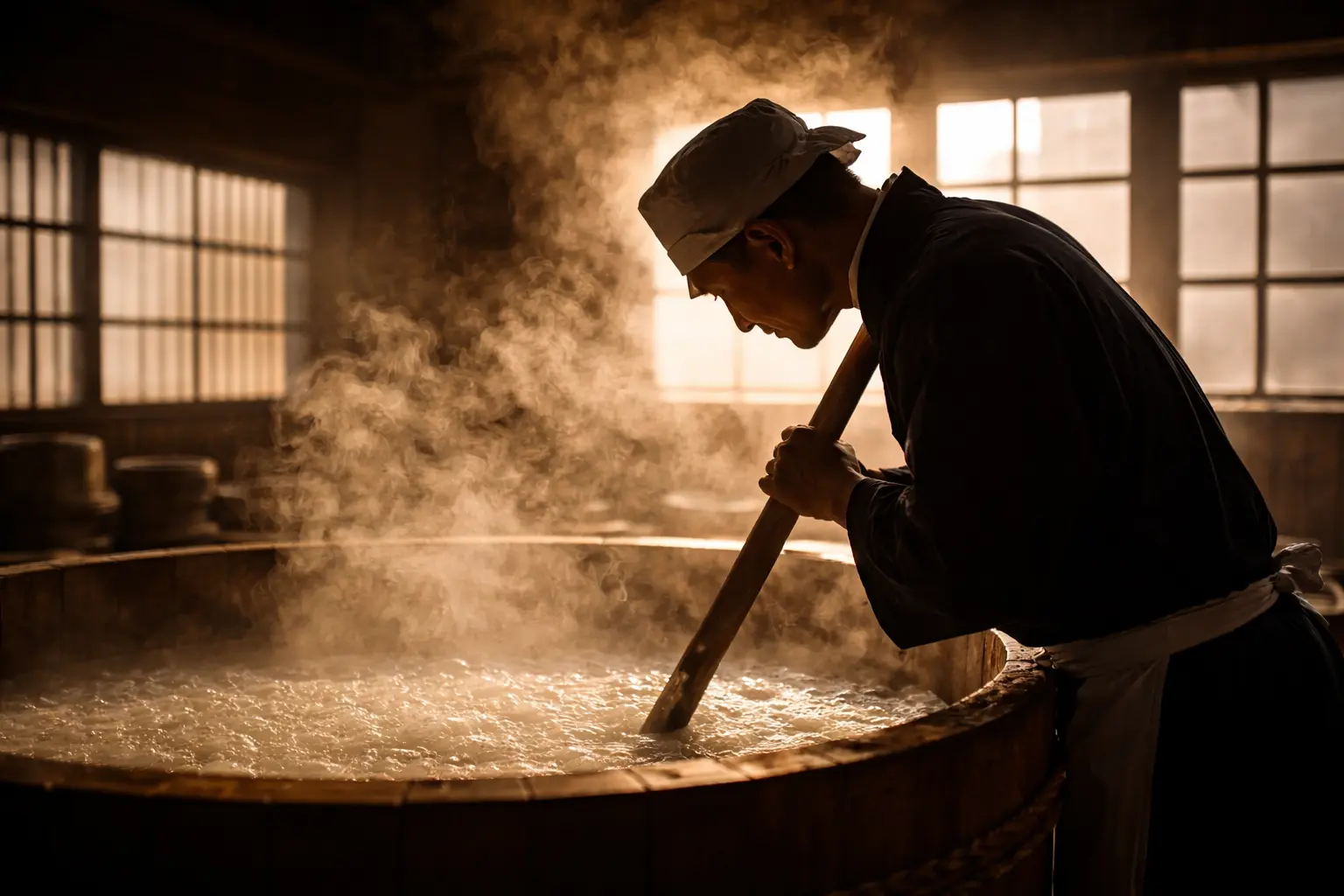
In 1904, the government founded the Brewing Research Institute. There, techniques that had been handed down within each brewery were re-explained in the language of microbiology and chemistry. When the distribution of “kyokai yeasts”—superior strains selected from the best breweries’ sake and purely cultured—began, sake quality rose across the whole country. This era also produced sokujo-moto, a yeast starter that adds lactic acid directly to finish faster, and yamahai-moto, a refinement of the traditional kimoto method.
The fact that brewing became stable and its yields predictable mattered greatly to the national treasury as well. From the Meiji era into the early Showa, the sake tax was one of the pillars of government revenue.
Rice Ran Short—The “Triple Sake” of the War Years
But the war that struck mid-20th-century Japan cast a deep shadow over brewing too.
Under World War II, rice was rationed, and the rice available for sake plummeted. To wring as much sake as possible from limited rice, brewers began adding large amounts of distilled brewing alcohol along with sugars and acidulants to increase volume. This sanbai-zojo-shu (triple-increased sake), or sanzoshu, which became common through the postwar years, secured quantity but could hardly be praised without reservation on flavor. The later image of sake as something that “gives you a bad drunk” or “lingers the next day” owes no small part to the sake of this era.
In 1943, with wartime revenue among the motives, the “grade system” was introduced. It ranked sake as special, first, or second grade, with tax rates varying by grade. Yet because a grade also depended on whether a brewery even submitted its sake for inspection, plenty of excellent sake was deliberately left unranked and sold as second grade. The system lasted until 1992.
Ginjo and Exports—The Present Day
Sake regained its shine only in the late 1980s, after a long stagnation.
One catalyst was ginjo sake. Made from highly polished rice fermented slowly at low temperatures, its fruit-like aroma and delicate flavor pleasantly overturned the assumption of “what sake is.” At the same time, a jizake (local sake) boom shone a light on the distinctive sake of small regional breweries, and brewers across the country stepped into the spotlight.
Around 1990, the “special-designation sake” system took hold in place of the old grades. Sorting sake into categories such as junmai, ginjo, and daiginjo by ingredients, rice-polishing ratio, and method, it did much to let consumers understand and choose what was in the bottle.
The number of breweries themselves, however, fell sharply. More than 3,000 sake makers in the 1970s had dropped to around 1,400 by the 2020s (per the National Tax Agency’s Sake no Shiori). Even so, dormant breweries are being revived and wholly new brewers are entering the trade across the country. Young makers who have taken over the family business are actively brewing sake unbound by old conventions.
And the gaze turns overseas as well. Since the start of the 21st century, sake exports kept climbing, setting record highs by value for thirteen consecutive years through 2022. In 2023 they eased to just over 41 billion yen amid declines to China and the United States, yet the price per liter has if anything kept rising (per statistics from the Japan Sake and Shochu Makers Association). New York, London, Paris—“sake” is now becoming a world word that passes as it is. Some brewers have even set up breweries abroad, and the very question of what sake is has quietly begun to be rewritten.
Rice, water, and koji. That combination of three has not changed at all from two thousand years ago. What changed is only the technology that handles them and the faces of those who drink. From an offering to the gods, to the drink of aristocrats, of temples, of the town, and now of the world. Into the cup you hold tonight, too, that long stretch of time is quietly dissolved. Hold it slowly on your tongue, and you may notice that you stand in the very newest line of a story running unbroken from a distant Yayoi village.
Learn more about sake production in How Sake is Made or What is Koji.