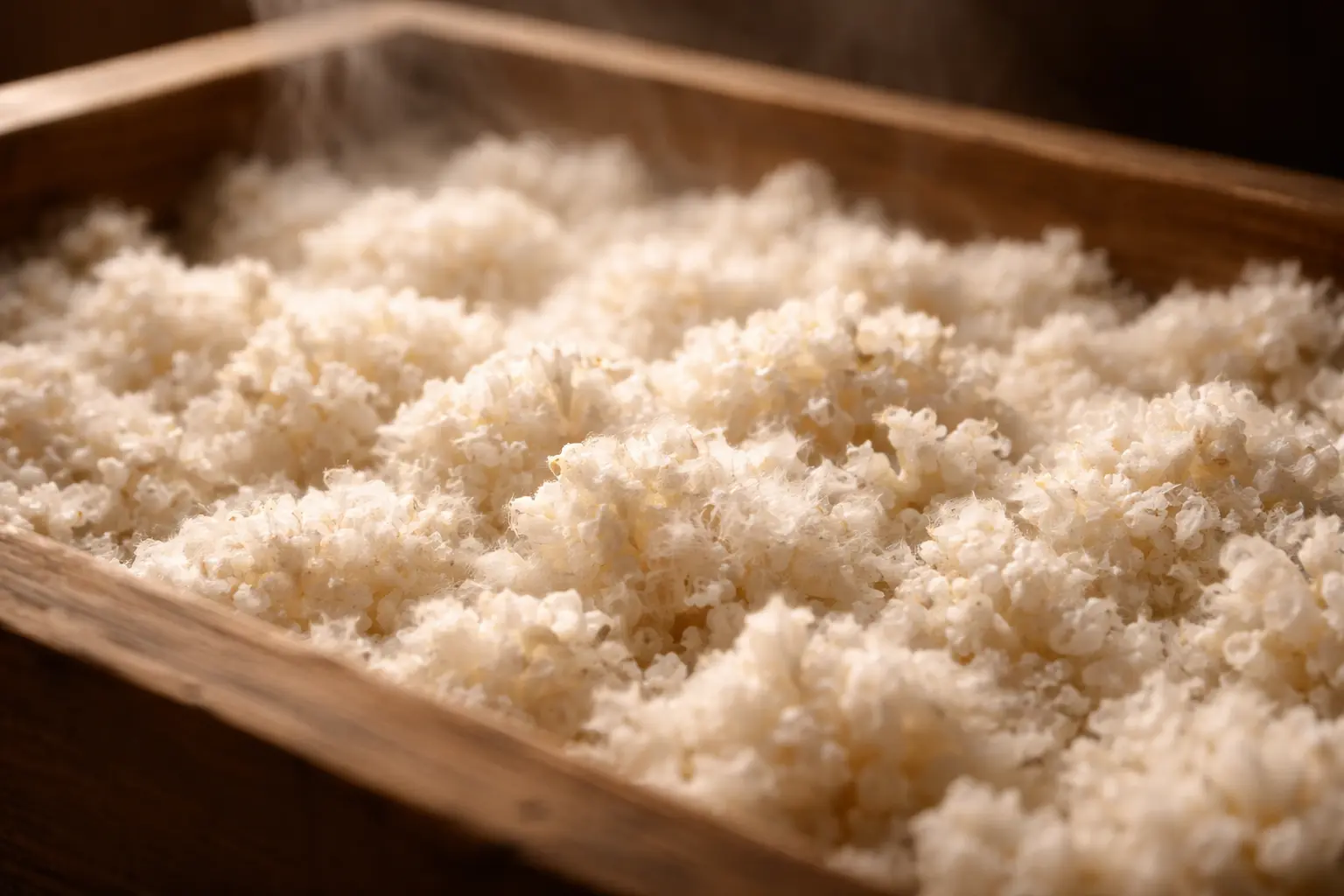
What is Koji and Why Does It Matter?
Understanding koji's essential role in sake brewing. Learn how koji mold works and why it's crucial to sake quality.
Without Koji, Sake Doesn’t Exist
Ask about sake ingredients and most people answer “rice.” That’s not wrong. But rice alone won’t become sake. The magic comes from koji.
In the sake world, there’s a saying: “Ichi koji, ni moto, san tsukuri”—first koji, second yeast starter, third brewing. The most important thing is koji, then the yeast starter, then the actual brewing process. Not the ingredients, not the water—koji comes first. That’s how much it determines sake’s character.
What Exactly Is Koji?
Koji is steamed rice with “koji-kin” (Aspergillus oryzae) mold cultivated on it.
Mold might sound concerning, but koji-kin is a safe microorganism used in Japan for centuries. Miso, soy sauce, mirin, vinegar—virtually all Japanese fermented foods involve koji. In 2006, the Brewing Society of Japan designated it the “National Fungus.” That’s how essential it is to Japanese food culture.
Invisible tiny organisms working quietly on rice—it looks unremarkable but accomplishes something extraordinary.
What Happens Without Koji?
Let me explain a bit of chemistry.
Wine grapes contain sugars ready for fermentation. Crush grapes, add yeast, and those sugars become alcohol—that’s wine.
Rice contains almost no sugar. It has starch. Yeast cannot convert starch directly to alcohol. Try fermenting rice as-is and you won’t get sake.
Enter koji. Enzymes from koji mold (amylase) break rice starch into sugar. Yeast then converts that sugar to alcohol. Koji acts as a translator between rice and yeast.
Sake’s Unique “Parallel Fermentation”
What makes sake fascinating is that saccharification and alcohol fermentation happen simultaneously—“parallel fermentation.” This is quite rare in world brewing.
Beer also involves converting starch to sugar, but saccharification finishes before fermentation begins—“sequential fermentation.” Sake has koji producing sugar while yeast immediately converts it to alcohol. This simultaneous process creates sake’s distinctive complex flavors.
Koji Creates Umami Too
Koji’s job extends beyond saccharification.
Koji mold also produces proteases—enzymes that break down proteins. These convert rice proteins into amino acids. Amino acids mean umami. That satisfying “delicious” sensation when drinking sake? Koji built that foundation.
Plus organic acids, vitamins, and aromatic compounds. A single ingredient, koji, essentially determines sake’s flavor structure.
48 Hours in the Koji Room
Making koji requires the brewery’s most careful attention.
In a dedicated room called the “koji-muro,” temperature stays at 30-35°C with humidity above 95% for roughly 48 hours. Throughout, the toji (master brewer) and workers check the koji every few hours—even through the night—adjusting temperature and breaking up clumps of rice.
Too hot and unwanted bacteria grow. Too cold and koji activity stops. Maintaining optimal conditions demands experience, intuition, and patience.
By day two, faint white filaments appear on the rice surface. Day three brings a sweet chestnut-like aroma. Finished koji shows every grain wrapped in fine white fuzz. Each tiny filament produces enzymes that shape the sake.
Koji “Type” Changes the Sake
Koji comes in two main types.
“Tsuki-haze” type has filaments penetrating deep into the rice grain. Strong saccharification power produces sake with robust umami. Suited for Junmai and Honjozo.
“So-haze” type has filaments thinly covering the grain’s entire surface. Gentler saccharification creates delicate, elegant sake. Often used for Ginjo and Daiginjo.
Neither is better—the choice depends on the target flavor. Same rice, different koji-making, completely different sake. This is where brewers show their skill.
Between Tradition and Science
Koji-making once relied entirely on craftsmen’s experience and intuition. Watching the koji, smelling it, touching it, judging based on that day’s temperature and humidity. A world beyond words.
Today, many breweries use automated temperature and humidity controls. This helps stabilize quality and improve efficiency.
Still, most breweries leave final decisions to humans. Machines miss subtle changes that craftsmen’s five senses detect. Traditional skills and modern science coexist quietly in the brewery.
The Heart of Sake
Koji is sake brewing’s heart.
Good koji produces good sake. Bad koji limits quality no matter how excellent the rice. The weight of “Ichi koji, ni moto, san tsukuri” becomes clearer the more sake you drink.
Next time you raise a glass, spare a thought for these tiny organisms. Invisible koji mold worked for dozens of hours inside rice grains. That effort sits in the glass before you.
Want more details on fermentation? See Yeast and Fermentation.