Sake Yeast: From Kyokai Strains to House Cultures
Yeast is not merely a microbe that makes alcohol. This article explains what really lies behind the apple- and banana-like ginjo aroma, how non-foaming yeast transformed production efficiency, and the way cerulenin-resistant strains rewrote the aromatic profile of sake—along with the history of yeast breeding.
Sake Yeast: The Invisible Star
The same rice, the same water, the same brewery, the same master brewer. Change the yeast, and you get a completely different sake.
When a sake strikes you as smelling “like apples,” the source of that aroma is neither the rice nor the water but a microorganism called yeast. And the yeast is not producing that aroma for our benefit. To the yeast, it is nothing more than a by-product of staying alive.
That by-product is what humans have spent a hundred years selecting, cultivating, and engineering.
What Yeast Actually Does
Yeast is a single-celled microorganism that converts sugar into alcohol and carbon dioxide. The same family of organisms makes bread rise and turns grape juice into wine.
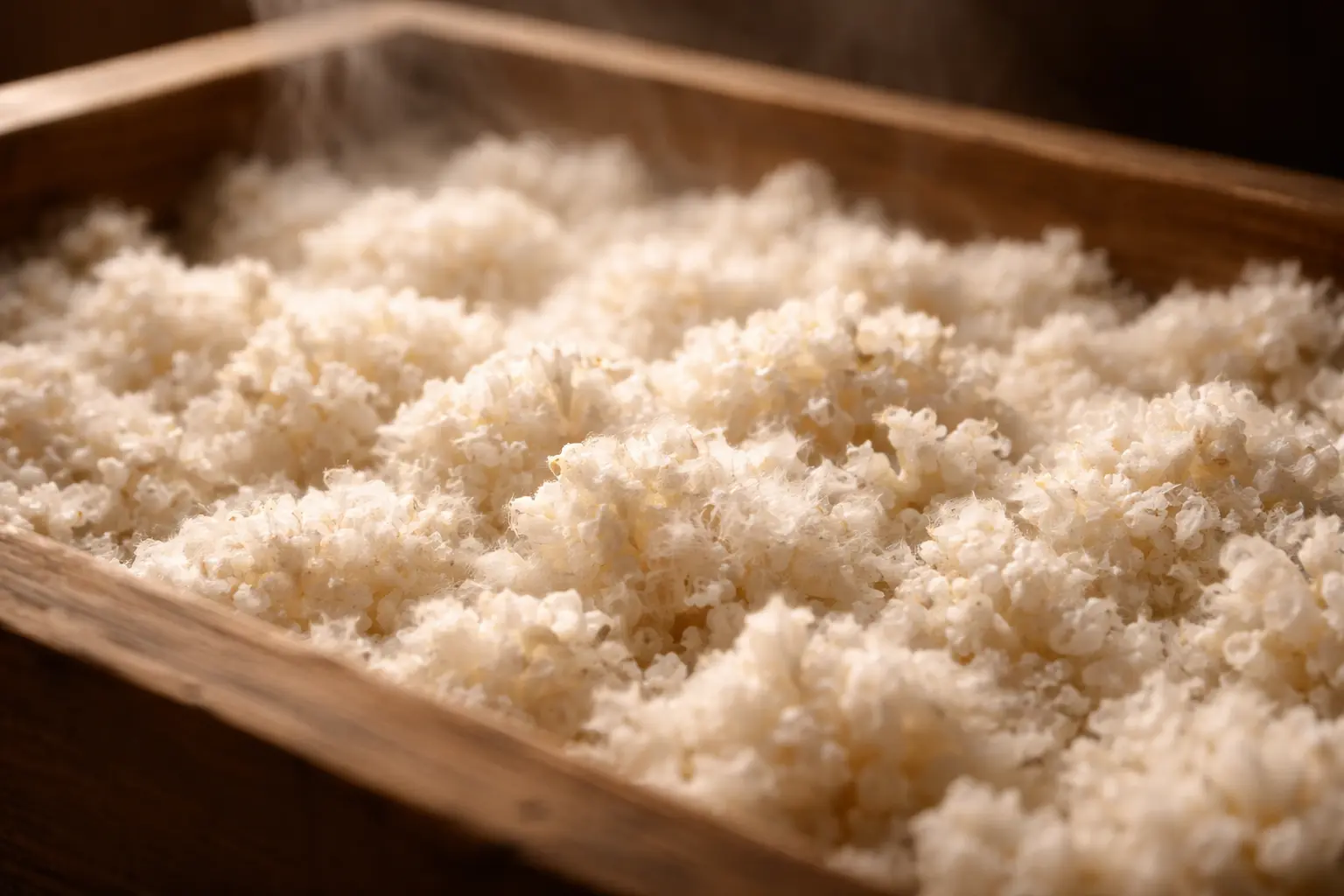
With sake, however, matters are a little more complicated. What the rice contains is starch, not sugar. Yeast cannot feed on starch directly, so koji mold must first break that starch down into sugar.
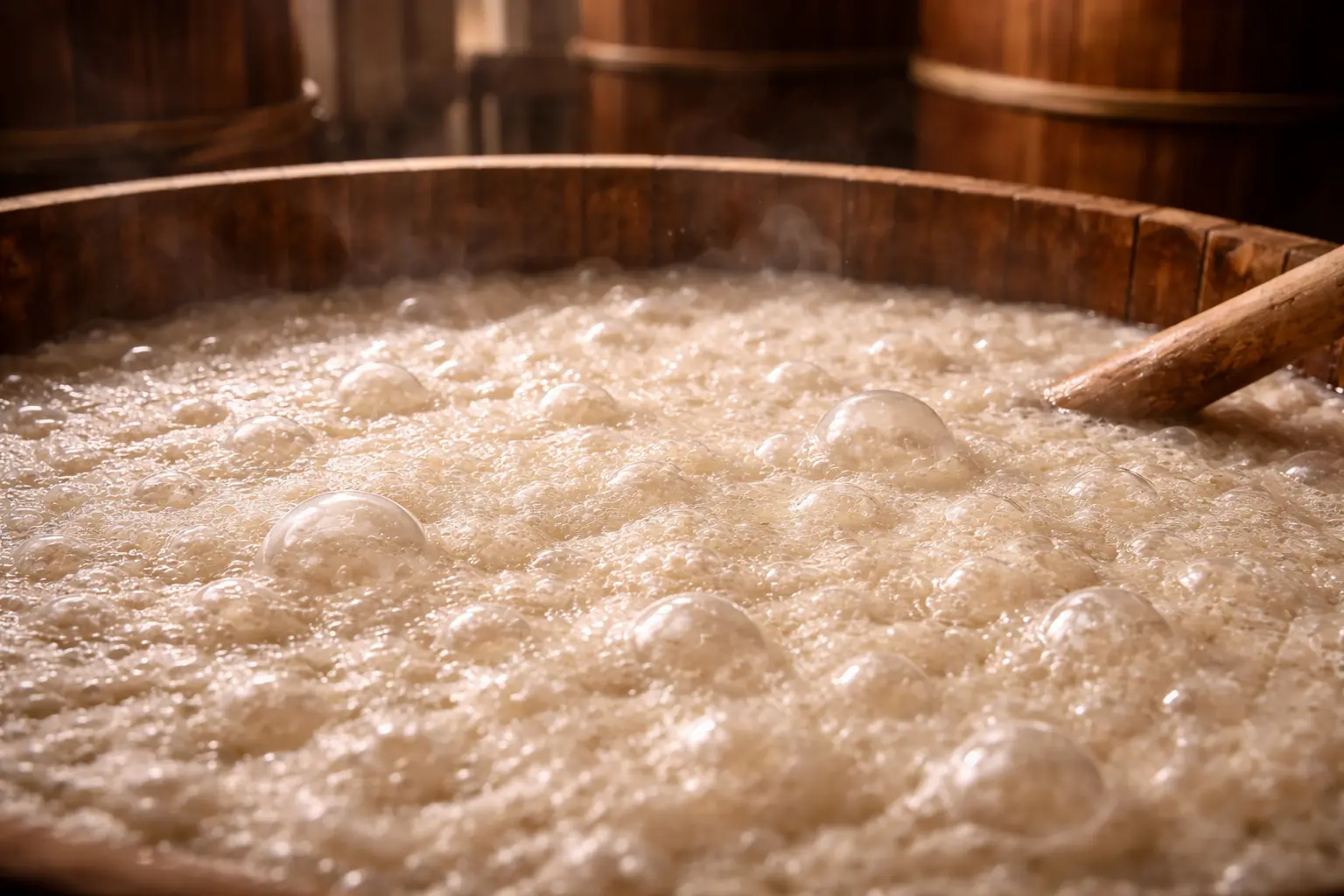
What makes sake unusual is that these two processes proceed simultaneously in the same tank. The koji produces sugar, and right alongside it the yeast converts that sugar into alcohol. This is called multiple parallel fermentation, and it is a rare approach among the world’s brewed beverages. Rather than completing saccharification before fermentation begins, as with beer, saccharification and fermentation run side by side.
Because of this, the sugar concentration in the moromi never climbs too high, and the yeast can keep working. The result is an alcohol content of around 20 percent—high for a brewed beverage.
Aroma Is a Metabolic By-Product
Producing alcohol is not the yeast’s only job. Over the course of fermentation it generates a range of aromatic compounds.
The leading players in the fruity aroma of ginjo sake are a group of compounds known collectively as esters. Two of them stand out.
Isoamyl acetate—an aroma suggesting banana and melon.
Ethyl caproate—an aroma suggesting apple and pear.
Both are built from intermediates that arise as the yeast metabolizes sugar. The yeast is not trying to make aromas; it releases these substances as a consequence of balancing its internal metabolism.
What matters is that the quantity produced depends heavily on fermentation temperature. Ferment slowly at a low temperature and the esters are less readily broken down, so they accumulate in the moromi. Ginjo brewing takes “long, low-temperature fermentation” as its guiding principle precisely in order to exploit this behavior.
Ginjo aroma, in other words, is a phenomenon that emerges when yeast metabolism and temperature control mesh. It is not something you obtain simply by adding a good yeast.
How the Kyokai Yeast System Works
From the Meiji era onward, Japanese sake brewing adopted a method of isolating yeast from breweries that had produced outstanding sake and distributing it across the country. The organization responsible is the Brewing Society of Japan, and the yeasts it distributes are known as Kyokai yeasts.
The numbers are assigned in the order the strains were isolated and adopted. Certain conventions govern them: a number in the 600s, such as No. 601, denotes the “non-foaming” mutant of the strain it came from—in this case No. 6. What that non-foaming property means is explained in the next section.
The strength of the Kyokai system is that one brewery’s achievement can be shared by the entire country. A superior yeast born in one region is given a number and delivered to breweries nationwide. Local sake is rooted in its place, but the microorganisms underpinning what is in the bottle have circulated far beyond their region of origin.
Three Turning Points in Yeast Breeding
Yeast has gradually shifted from something to be “found” to something to be “designed.” That progression can usefully be divided into three stages.
The First Turn: Non-Foaming Yeast (1970s)
Fermenting moromi foams violently. A high foam rises far above the surface of the liquid, and if it overflows the tank, fermentation is thrown off. Breweries therefore had no choice but to leave a great deal of headroom in the tank. Foam caps and foam-breaking devices were required as well, and managing the foam was a mass of labor and cost.
The solution adopted for this problem was to create a yeast that does not foam. Full-scale research began in 1963, and in 1973 (Showa 48) Ouchi Kozo and Akiyama Yuichi isolated a non-foaming mutant of No. 6 yeast and put it into practical use. This is Kyokai No. 601.
The impact was substantial. The same tank capacity could now yield roughly 20 to 30 percent more sake, foam caps and foam breakers became unnecessary, and the number of days on the moromi could be shortened. This was breeding that changed not the flavor but the manufacturing process itself—which is what makes it such a landmark achievement.
The Second Turn: Aromatic Yeast (mid-1990s)
What came next was a dramatic intensification of aroma.
The key was a property called cerulenin resistance. Cerulenin inhibits fatty acid synthase, and when you select for mutants able to survive in its presence, the balance of fatty acid chain lengths shifts. The result is that production of ethyl caproate increases dramatically.
The yeasts bred this way, with their showy apple-like aromas, became known as aromatic yeasts, and the outstanding example is Kyokai No. 1801. It is low in acidity, produces ethyl caproate in quantity, and keeps isoamyl alcohol formation in check. It spread nationwide in the mid-1990s and rewrote the aromatic standard for daiginjo entered in judging competitions.
Much of what we now register as a “ginjo-like” showy aroma comes from this lineage of yeast. That said, strongly aromatic yeasts are demanding to handle, and some point out that the resulting sake is hard to pair with food, so certain breweries deliberately avoid them.
The Third Turn: A Return to Place
Once the competition over aroma had run its course, a movement in the opposite direction became conspicuous.
House yeast—attempts to isolate and use the wild yeast living in a brewery. Maintaining proprietary strains—the practice of preserving a yeast isolated in-house rather than relying on Kyokai strains. And regional yeast—yeast developed independently by a prefectural research institute and shared among that prefecture’s breweries.
Regions that hold yeast of their own are increasing, as with Yamagata Yeast in Yamagata and Utsukushima Yume Yeast (F7-01) in Fukushima. Having passed through an era in which nationally standardized yeast lifted technical standards across the board, regions are now finding value in “our own microorganisms.”
How to Approach This as a Drinker
Yeast information is sometimes printed on the label or in the product description. You can use it as a clue to predict flavor.
If you want a sake with a strong, showy aroma, look for one made with an aromatic yeast such as those in the No. 1801 line. Chilled and served in a wine-glass-like vessel, its character comes through clearly.
If you want a sake that accompanies a meal, one made with a mild-aroma yeast such as the No. 6 or No. 7 lines suits better. It stays out of the food’s way and takes readily to being warmed.
If you want to taste the character of a place, try a sake that advertises a house yeast or a regional yeast. It has an outline that differs from the national standard—one that only that brewery or that prefecture can produce.
Even so, yeast alone does not determine a sake. Rice, water, polishing ratio, fermentation temperature, and the brewer’s judgment are all bound up in it. Yeast is only one variable. When it comes to aroma, however, it is unquestionably the variable with the greatest influence.
Yeast is only doing the simple job of eating sugar and giving off alcohol. The apple aroma and the banana aroma alike are nothing more than by-products that leaked out along the way.
What humans have done is to distinguish those by-products, amplify them, and reshape them into something manageable. We made a yeast that does not foam, multiplied the aroma several times over, and lately have gone back to searching for the yeast of our own ground.
The aroma in the glass rises up where the physiology of a microorganism overlaps with a hundred years of human observation.
The workings of koji are explained in detail in What Is Koji.
For the relationship between yeast lineages and regions, see also Regional Sake Styles Across Japan.
References: Brewing Society of Japan (Kyokai yeasts), SAKE Street, “What Are the ‘Kyokai Yeasts’ That Support Sake Brewing?” and “What Is the ‘Non-Foaming Yeast’ Used in Sake Brewing?”, Journal of the Brewing Society of Japan (breeding of sake yeast with high ethyl caprylate productivity), and published information from the Gekkeikan Research Institute