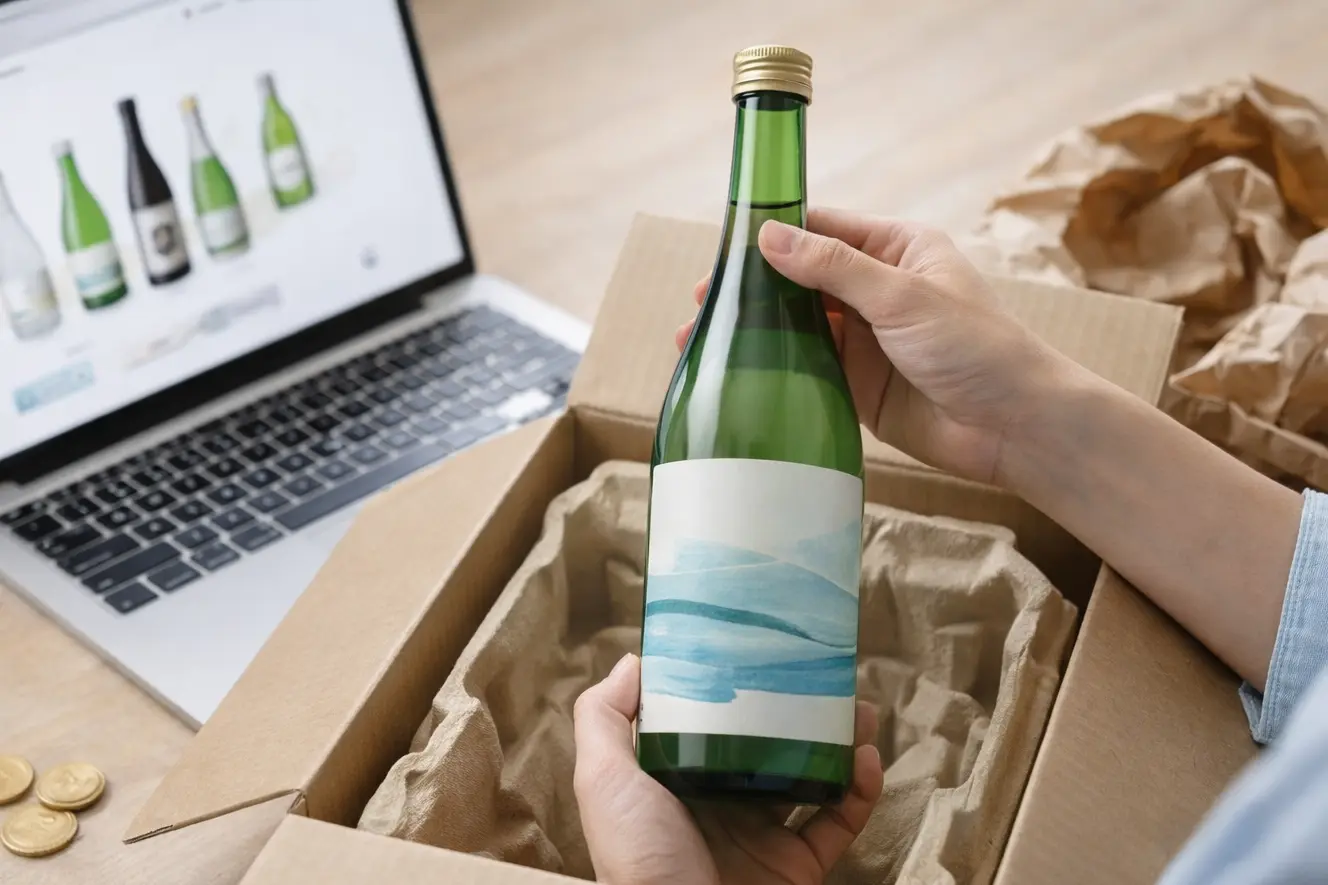
Online Sake Buying Guide: How to Shop with Confidence
Essential tips for buying sake online. How to choose reliable shops, verify storage conditions, and avoid common pitfalls. Make your first online sake purchase with confidence.
Learning to Buy Sake Online from the Mistakes People Make
Online shopping is wonderfully convenient. Sake from a brewery halfway across the country, a limited release you would never spot on a supermarket shelf, an order placed at midnight on a whim—all of it arrives at your door. But there is one thing that a screen can never show you: how the bottle was stored and how it traveled before it reached you.
At a physical shop, you gather a surprising amount of information without even trying. You feel the temperature of the room. You notice whether the bottles sit in a refrigerated case. You see the condition of the labels, and you can ask the owner when a bottle came in. Online, all of that is invisible. That invisibility is exactly where things go wrong.
Below are four mistakes that beginners often make when buying sake online, along with practical ways to avoid each one. None of them are hard to sidestep once you know what to look for.
Mistake One: Ordering Nama-zake by Room-Temperature Shipping in Summer
Nama-zake is unpasteurized, which makes it fragile in the face of heat. In midsummer, the cargo area of a delivery truck can climb past 40°C. Send a bottle of nama-zake through ordinary room-temperature shipping, and it may already be degraded by the time it lands on your doorstep.
The fix is simple: choose refrigerated shipping, and treat it as the only option. If the shop lets you pick a shipping method, specify cold delivery. Set a delivery date and time when you know you will be home to receive it, and move the bottle into the fridge the moment it arrives. If a shop offers no refrigerated shipping at all, take that as a sign they do not fully understand what they are selling. Cold shipping costs a few hundred yen more, but skimping on that small amount only to ruin an entire bottle is a poor trade.
Mistake Two: Overlooking the “Keep Refrigerated” Label
The second common slip is skimming past the notes on the product page—the “keep refrigerated” line and the storage details. Twice-pasteurized junmai and honjozo hold up reasonably well at room temperature, but nama-zake, nama-zume, and nama-chozo all assume cold storage from start to finish.
The remedy is to read the listing carefully before you buy. Three things are worth checking. First, the production date: for nama-zake, aim for within three months, and even for pasteurized sake, within a year is a good guideline. Second, the storage method: does it say refrigeration required, or is room temperature acceptable? Third, whether it has been pasteurized at all—watch for the character “nama” (raw). A good shop provides this information openly. Once the bottle reaches your home, keep following those same instructions, and buy only as many bottles as will actually fit in your fridge.
Mistake Three: Opening It Right Away and Stirring Up the Sediment
The vibrations of transit leave the contents of a bottle stirred up. In nigori-zake and ori-zake, the sediment is swirling. Open the bottle straight away and a carbonated type can foam over, while the sediment mixes in only halfway. Even a clear sake can have its aromatic balance thrown off for a while.
The fix is to let it rest before you open it. Stand the bottle upright in the fridge and give it half a day to a full day to settle. Standing it upright limits oxidation and keeps sake from sitting against the cap. For nigori and sparkling types, loosen the cap a little at a time to let the gas escape gradually. And if you simply cannot wait to drink it, choose a pasteurized sake, which tolerates the jostling of shipping far better.
Mistake Four: Getting Stuck with an Overpriced Reseller Bottle
Popular labels and limited releases are hard to obtain through official channels. That scarcity tempts people into a fourth mistake: reaching for reseller bottles on large marketplaces or flea-market apps at several times the list price. The inflated cost stings, but the real problem is that the storage history is unknown. The bottle may have sat in a room-temperature stockroom or in direct sunlight. And the more sought-after a label is, the more likely it is a nama-zake or a limited shipment that is especially sensitive to temperature.
The way around this is to patiently work the official routes. A brewery’s own website or an authorized specialty retailer sells at list price. Use the “list of stockists” on the brewery’s site to trace your way back to a legitimate seller. Sign up for lottery sales and restock-notification emails, and follow breweries on social media. And before you hand over a large sum for a label you cannot get, try something in the same vein instead—a standard bottling from the same brewery, or a sake from another brewery in the same region or using the same rice, will often deliver a very similar satisfaction.
Know the Character of Each Buying Channel
It helps to have a rough sense of where to shop. Buying direct from the brewery offers the most trustworthy storage, but the selection is limited to that single brewery, and higher shipping costs make bulk orders the norm. An online shop run by a local-sake specialist is the real workhorse of online buying: they bring knowledge and refrigeration, they let you choose across many breweries, and even at a slightly higher price the reassurance is worth paying for. Large marketplaces win on selection, price comparison, and reward points, but freshness varies from one seller to the next, so check whether the seller is the brewery itself or an authorized dealer. Subscriptions introduce you to sake you would never have picked yourself, chosen by someone with a discerning palate—though you cannot select the label, and cold-chain handling depends on how the service is run. If this is your first time, buy a single pasteurized junmai from a specialist’s online shop, and once you are satisfied, try a nama-zake from the same store—expanding your range a little at a time.
Buying from Overseas
If you live outside Japan, the same principles apply, but a few extra realities are worth keeping in mind. Ordering shipped directly from Japan tends to mean high shipping costs and long transit times, and the longer a bottle spends in transit, the harder it is to keep its temperature under control. There may also be customs duties, alcohol or import taxes, and paperwork to clear before the bottle reaches you.
Because temperature is so difficult to manage over a long-distance journey, nama-zake carries a much higher risk when shipped internationally; pasteurized sake, which handles temperature swings far better, is the safer choice for that kind of trip. Where you can, consider buying from a specialist sake retailer or importer based in your own country. They have already handled the import and can usually manage storage and last-leg delivery far more reliably than a single bottle traveling solo across the world. It is often the calmer, more dependable path to the sake you want.
In Closing: Finding One Shop You Trust Is the Best Shortcut
All four mistakes share the same root: treating storage and freshness as afterthoughts. Find a single shop that handles the fundamentals with care—refrigerated storage, cold shipping, clearly stated production dates—and you will avoid nearly all of these pitfalls. Rather than drifting from shop to shop, building a long relationship with one you trust is the faster road.
A good shop answers questions honestly. Try asking, “Can you tell me about your storage conditions?” and see how they respond. If a bottle arrives in poor shape, photograph it before you open it and describe the problem specifically; an honest shop will offer an exchange or a refund. Once you can trust one shop, it becomes more than a place to buy—seasonal recommendations, suggestions for new labels, a running conversation about what to try next.
We live in an age when delicious sake from every corner of the country arrives at the tap of a finger. Learn the shapes these mistakes take, keep one shop you can rely on, and online shopping will widen your world many times over.
For more about sake, check out Enjoying Sake Overseas.