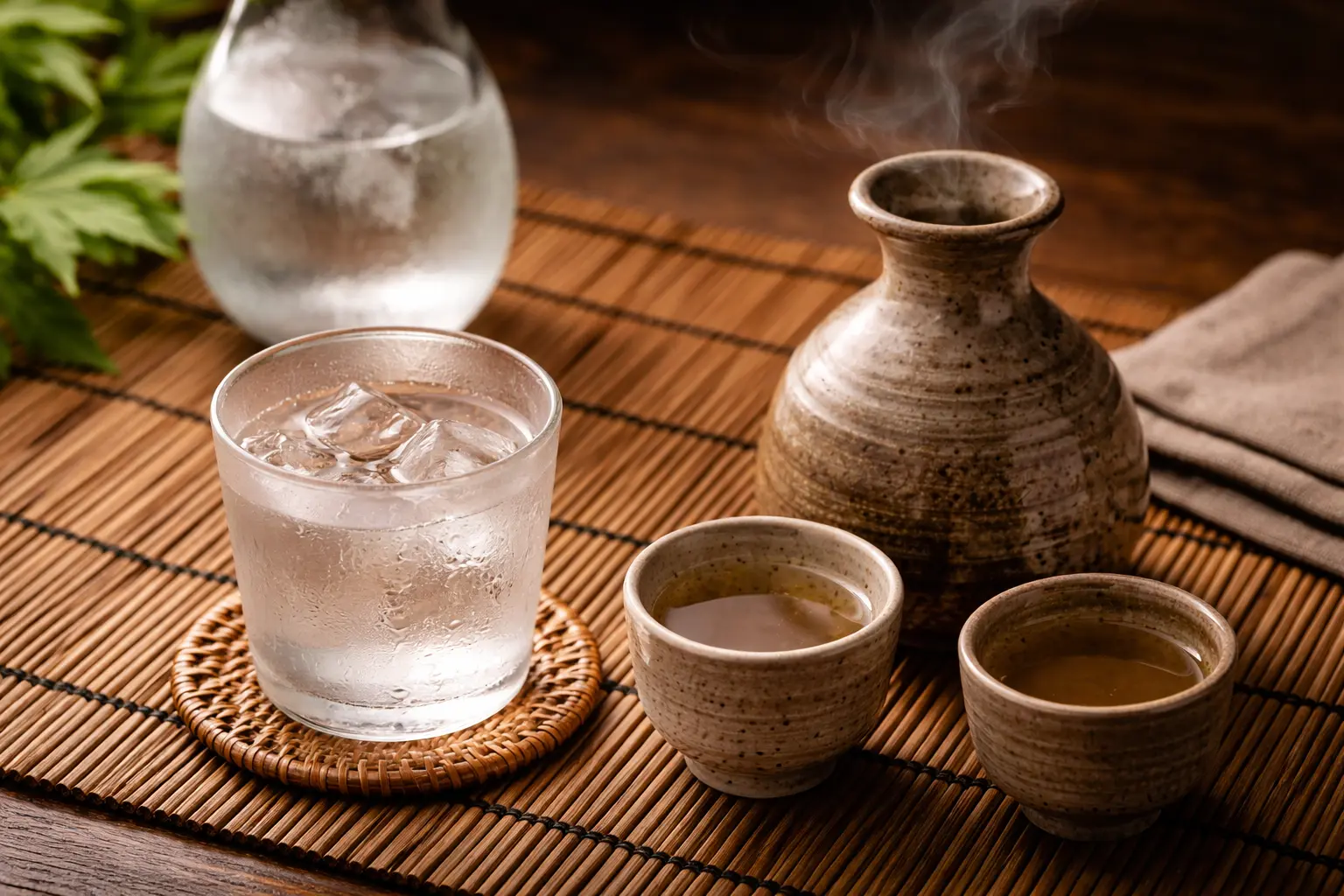
Sake Serving Temperatures: How Flavor Shifts from Chilled to Hot
Sake is unusual in that it is enjoyed anywhere from 5°C to 55°C, with a name for each of its ten temperature bands. This guide explains why temperature changes flavor—through aroma volatility and the way we perceive taste—along with the ideal range for each style of sake and a reliable method for warming it.
Sake Serving Temperatures: One Bottle, Many Faces
Drink the same label side by side—once at room temperature, once warmed—and the impression can change so completely that it seems like two different drinks. Anyone who spends a while with sake runs into this sooner or later.
Wine and beer have their ideal serving temperatures too, but a drink routinely enjoyed across a span from 5°C to 55°C (41°F to 131°F) is close to unheard of anywhere in the world. And in sake’s case, every band within that span has a name of its own.
Ten Temperatures, Ten Names
The scale is divided in 5°C steps, and each step carries a name drawn from a season or a scene.
| Temperature | Name | What it feels like |
|---|---|---|
| 5℃ | yukibie (雪冷え, “snow-chilled”) | Straight from the fridge, cold enough for the bottle to sweat |
| 10℃ | hanabie (花冷え, “blossom-chilled”) | Out of the fridge and left to stand a short while |
| 15℃ | suzubie (涼冷え, “cool-chilled”) | About wine-cellar temperature; the chill has softened |
| 20℃ | hiya (冷や, “cool”) | Room temperature—not cold at all |
| 30℃ | hinatakan (日向燗, “sunlit warm”) | Only faintly warm to the touch |
| 35℃ | hitohadakan (人肌燗, “body warm”) | Around body temperature; hard to register as warm |
| 40℃ | nurukan (ぬる燗, “lukewarm”) | Gently warm—the entry point to heated sake |
| 45℃ | jokan (上燗, “properly warm”) | Reads as hot in the mouth |
| 50℃ | atsukan (熱燗, “hot”) | Distinctly hot |
| 55℃ | tobikirikan (飛びきり燗, “extra hot”) | Hot enough that the cup is a challenge to hold |
Snow, blossoms, coolness—there is something appealing about borrowing seasonal imagery to describe degrees of cold. The names on the warm side, “sunlit” and “body warm,” come from bodily sensation instead. All of which means these distinctions were drawn this finely by feel alone, in an age without thermometers.
One point worth flagging: hiya means room temperature, not cold sake. Before refrigeration, any sake that had not been warmed was simply at room temperature. That original meaning is why ordering “hiya” at an izakaya can still get you a room-temperature pour. If you want something cold, asking for reishu (冷酒) is the safer phrasing.
Why Temperature Changes the Flavor
Four things shift as the temperature moves.
How the Aroma Lifts
Aromatic compounds reach the nose by evaporating, and they evaporate more readily as the temperature climbs. Warm the sake and the aroma rises more strongly.
That cuts both ways. The delicate aromatics of a ginjo can surge all at once when heated and then fall apart. Chill it too hard, on the other hand, and almost nothing comes off the glass.
For sake you are drinking for its aroma, then, somewhere around 10–15°C—the point where the bouquet is just beginning to open—tends to be the right call.
How Sweetness Registers
Sweetness is generally said to register most strongly near body temperature. Cold things read as less sweet.
The clean impression of chilled sake comes not from any drop in sugar content but from sweetness being harder to detect. Warm the same sake and its sweetness and umami seem to swell.
So the familiar experience of “it gets sweeter when you warm it” has less to do with the sake changing than with a change on the tasting side.
Acidity, Bitterness, and Alcohol Bite
Acidity and bitterness stay in the background when cold and gain presence as the temperature rises. The bite of alcohol behaves the same way, growing sharper the hotter the sake gets.
When atsukan comes across as harsh, this is usually the reason. Dropping the temperature slightly is often all it takes to change the impression.
Mouthfeel (Viscosity)
Liquids become less viscous as they warm. That is part of why warmed sake seems to slip down more smoothly.
Which Sake at Which Temperature
Different styles come into their own in different temperature bands. Working from the four-type classification of sake makes the choice easier.
Kunshu (aromatic and light)—daiginjo and ginjo. Around 10°C (hanabie) is the baseline. Over-chilling closes the aroma down; warming throws the balance off. This group has a narrow tolerance for temperature.
Soshu (restrained aroma, light)—honjozo, futsushu, and namazake. Well chilled at 5–10°C, their lightness stands out. The easiest type to handle in summer.
Junshu (restrained aroma, substantial)—junmai, and particularly kimoto and yamahai. These show what they can do warmed to 40–50°C. Many stay closed when cold and only open up their umami with heat. This is where the real subtlety of sake temperature lives.
Jukushu (aged and concentrated)—koshu and long-aged sake. These handle everything from room temperature to warmed. A little heat helps the complex aromas unwind.
When in doubt, take a sip at room temperature first. Deciding from there whether it seems like it wants chilling or would open up with warmth rarely leads you far wrong.
How to Warm Sake
Water Bath (Recommended)
The method least likely to go wrong.
- Fill the tokkuri to about 80% (fill it to the brim and it will overflow as it warms)
- Bring water to a boil in a pot, then turn off the heat
- Lower the tokkuri in up to its neck and wait 2–3 minutes
- Touch the base of the tokkuri to check the temperature
If the water is too hot, only the outside heats up, so always take the pot off the heat once it boils before using it. The trick is waiting for the warmth to reach the center of the tokkuri evenly.
Microwave
Convenient, but the top heats faster than the bottom and the result is easily uneven.
To counter that, take it out partway through and stir it gently, or heat it with a stirrer or a pair of chopsticks standing in it. Around 50 seconds at 500W per go (180 ml) is the rough guide, but machines vary a great deal, so it is safer to set a shorter time and check.
Judging Without a Thermometer
A thermometer is the sure thing until you get the feel for it, but these sensations work as a guide.
- The base of the tokkuri is warm—hitohadakan (around 35°C)
- The whole tokkuri is warm but still holdable—nurukan (around 40°C)
- Hot to hold, with a faint wisp of steam—jokan (around 45°C)
- Uncomfortable to keep holding—atsukan (50°C and up)
If you can clearly see steam coming off the mouth of the flask, you are already into atsukan territory.
Kanzamashi: Enjoying the Cooldown
The process of warmed sake gradually cooling is called kanzamashi, and some people seek it out deliberately.
Sweetness and umami that were hidden while the sake was hot emerge as the temperature falls. A single bottle lets you follow a continuous shift in flavor from 50°C down to 30°C, which is a way of drinking that belongs to sake alone.
There is nothing wrong with reheating it once it cools. You will sometimes hear that rewarming sake is a bad idea, but for drinking at home it is not worth worrying about.
A Note on Chilling
Over-chilling wastes a sake just as surely as overheating it.
Refrigerators generally sit around 5°C, which puts them at yukibie. Letting the bottle stand for ten minutes rather than pouring it straight out often leaves both aroma and flavor more open.
Serving sake over ice lowers the alcohol content and makes it easier to drink, but it also dilutes the flavor. That approach suits sake that was rich to begin with, or a high-proof genshu.
Common Mistakes
Serving ginjo as atsukan—its aromatic structure comes apart easily, and the very quality you paid for is lost. If you want to try it, stop at around hitohadakan.
Drinking it the moment it leaves the fridge—the aroma is still closed. Waiting a little changes the impression.
Overheating it in the microwave—the alcohol drives off and the flavor turns hard-edged. Keep it short and check as you go.
Locking a sake to one temperature—decide that “this label is a hiya sake” and you only ever know half of it. Trying the same bottle at different temperatures is the surest way to find something new.
There is no correct answer when it comes to sake temperature. A sake one person considers at its best as nurukan is one another would rather drink at room temperature. That is fine.
Still, drinking a whole bottle at a single temperature is simply a missed opportunity. If a bottle is going to last you several days, try it chilled on the first day, at room temperature on the second, warmed on the third—that alone brings the shape of the sake into much fuller relief.
Temperature is the other axis sake has been given.
For the characteristics of each style of sake, see Types of Sake Flavor.
Ways of drinking sake for different occasions are covered in How to Drink Sake.
References: SAKETIMES, “Atsukan, Nurukan, Yukibie: Ways to Enjoy Sake by Temperature”; Takara Shuzo, “Understanding Sake”; Sawanotsuru, “Sake Mizuki”