How to Order Sake at an Izakaya: A Guide to Confident Ordering
Essential knowledge for ordering sake at an izakaya. From reading menus to ordering phrases and etiquette. A guide to enjoying sake with confidence, even for first-timers.
Enjoying Sake at an Izakaya
You open the izakaya menu and see sake lined up.
You don’t know what to order. You don’t want to embarrass yourself.
Here’s how to order sake at an izakaya to ease those worries.
How to Read the Menu
Basic Terms
Meigara (銘柄) The sake’s name. “Dassai,” “Kubota,” “Hakkaisan,” etc.
Tokutei Meisho (特定名称) The type of sake. “Junmai-shu,” “Ginjo-shu,” “Daiginjo,” etc.
Go (合) Unit of measurement for sake. One go is about 180ml.
Tokkuri (徳利) The vessel for serving sake. Usually holds one to two go.
Ochoko / Guinomi Small cups for drinking sake.
Understanding the Menu
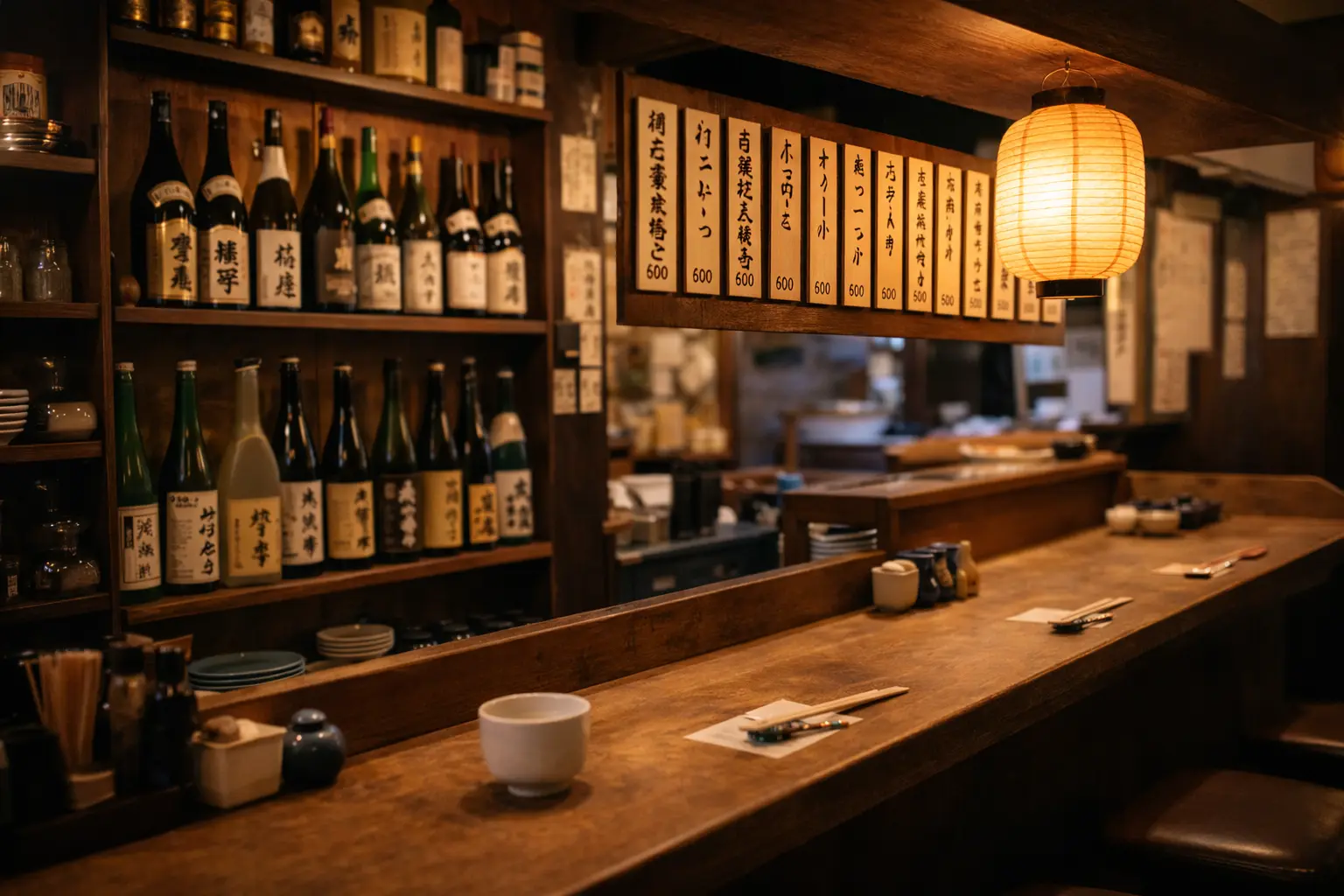
Izakaya menus typically look like this:
【Japanese Sake】
・Dassai Junmai Daiginjo    1 go ¥800
・Kubota Senju              1 go ¥600
・Shimeharitsuru Jun        1 go ¥550
・Local Sake Today's Pick   Glass ¥450
The format is: Brand + Type + Amount + Price.
Temperature Terms
Reishu (冷酒) / Hiya Chilled sake. Around 5-15°C.
Room Temperature / Hiya (冷や) Note: “Hiya” can mean room temperature, not refrigerated. Always confirm.
Kan (燗) Heated sake. Temperature names vary:
- Nurukan: Around 40°C
- Atsukan: Around 50°C
- Tobikiri-kan: 55°C and above
How to Order
Basic Ordering Phrases
Simple Order “Dassai o ichi-go kudasai” (One go of Dassai, please)
Specify Temperature “Kubota o hiya de ichi-go onegaishimasu” (One go of Kubota, chilled, please) “Shimeharitsuru o nurukan de onegaishimasu” (Shimeharitsuru, warm, please)
Ask for Recommendations “Osusume no nihonshu wa arimasu ka?” (What sake do you recommend?) “Kyou no ryouri ni au nihonshu o oshiete kudasai” (What sake pairs with today’s dishes?)
When You Don’t Know, Just Ask
No need to be embarrassed. Staff will kindly explain.
Useful Phrases
- “Nihonshu shoshinsha nan desu ga, nomiyasui no wa dore desu ka?” (I’m new to sake, which is easy to drink?)
- “Amakuchi / karakuchi de osusume wa arimasu ka?” (Any sweet/dry recommendations?)
- “Kono ryouri ni au nihonshu wa arimasu ka?” (What sake goes with this dish?)
- “Ninki no meigara wa nan desu ka?” (What’s your most popular brand?)
Tasting Sets
Many izakayas offer “nomi-kurabe sets” (tasting sets).
These let you try about 3 types of sake in small amounts. Great for beginners to try different flavors and find your preference.
Etiquette to Know
The Culture of Pouring (O-shaku)
Japan has a culture of “o-shaku” (pouring for others).
When Receiving When someone pours for you, hold your cup with both hands. Say “arigatou gozaimasu” (thank you) after they pour.
When Pouring Hold the tokkuri with both hands and pour into their cup. Don’t overfill—about 80% is good.
When Declining If you can’t drink more, politely say “mou juubun desu” (that’s enough for me). Leaving some sake in your cup signals you don’t want a refill.
At casual izakayas, you don’t need to be too formal about this.
Things to Avoid
Don’t Leave Your Cup Empty This signals “pour me more.” If you’re done, leave a little in your cup.
Don’t Drink While Being Poured Wait until they finish pouring before drinking.
Don’t Point the Tokkuri Spout Up When pouring, don’t point the spout toward the other person. Keep it sideways or down.
Counter Seat Enjoyment
At counter seats, conversation with the owner or chef is part of the experience.
“Kono osake, donna tokuchou ga arimasu ka?” (What’s special about this sake?) “Kono ryouri ni au osake wa arimasu ka?” (What sake goes with this dish?)
Ask, and they’ll happily share their knowledge.
Food Pairings
Basic Principles
Match Intensity
- Light dishes → Light, clean sake
- Rich dishes → Full-bodied sake
Match Temperature
- Cold dishes → Chilled sake
- Warm dishes → Heated sake
Classic Pairings
Sashimi & Sushi Clean Junmai or Ginjo, chilled. Won’t overpower the fish.
Tempura Dry Honjozo or Junmai. Cuts through the oil.
Yakitori For salt: Light, clean sake. For sauce: Rich Junmai.
Hot Pot Heated sake is best. Warms you up. Junmai recommended.
Cheese & Western Food Surprisingly compatible. Try fruity Ginjo.
Paying the Bill
Sake Price Ranges
Reasonable (¥400-600 per go) Often local sake or Honjozo. Good for everyday drinking.
Standard (¥600-900 per go) Junmai, Junmai Ginjo. Well-balanced price range.
Premium (¥1,000+ per go) Daiginjo or rare brands. For special occasions.
All-You-Can-Drink Sake
Sake included in all-you-can-drink plans is often limited in selection.
If you really want to enjoy sake, ordering individually is recommended.
Troubleshooting
Got Something Different?
Ask “Sumimasen, kore wa nan to iu osake desu ka?” (Excuse me, what’s this sake called?). They’ll exchange it if there’s a mistake.
Didn’t Like It?
It’s okay to leave some. Try a different brand next time. “Kono kei-tou ja nakute, motto amakuchi / karakuchi no mono wa arimasu ka?” (Rather than this style, do you have something sweeter/drier?)
Drank Too Much?
Ask for water (yawaragi-mizu). Ideally drink as much water as sake. Nothing to be embarrassed about.
Useful Japanese Phrases
Ordering
- ”○○ o ichi-go kudasai” (One go of ○○, please)
- “Reishu de onegaishimasu” (Chilled, please)
- “Kan ni shite kudasai” (Please warm it)
Questions
- “Osusume wa nan desu ka?” (What do you recommend?)
- “Karakuchi no osake wa arimasu ka?” (Do you have dry sake?)
- “Jimoto no osake wa arimasu ka?” (Do you have local sake?)
Impressions
- “Oishii desu ne” (This is delicious)
- “Fruity desu ne” (It’s fruity)
- “Nomiyasui desu” (Easy to drink)
More / Finishing
- “Onaji mono o mou ichi-go” (Another go of the same)
- “Okaikei onegaishimasu” (Check, please)
For International Visitors
Japanese izakayas are friendly to international visitors.
More places now have English menus. Try asking “Do you have English menu?”
Saying “Sake” works for Japanese sake. Terms like “Junmai” and “Ginjo” can be used as-is.
Summary
No need to be intimidated by sake at izakayas.
If you don’t know, just ask. That’s all.
Staff want you to enjoy sake. Say “I’m a beginner” and they’ll happily recommend something.
Start with a tasting set and explore your preferences. You’ll surely find your perfect cup.
For more about sake, check out Sake for Non-Lovers.