How to Order Sake at an Izakaya: A Guide to Confident Ordering
Essential knowledge for ordering sake at an izakaya. From reading menus to ordering phrases and etiquette. A guide to enjoying sake with confidence, even for first-timers.
The Night I Froze at an Izakaya
In my early twenties, my boss took me to a sake specialty izakaya.
I opened the menu and froze.
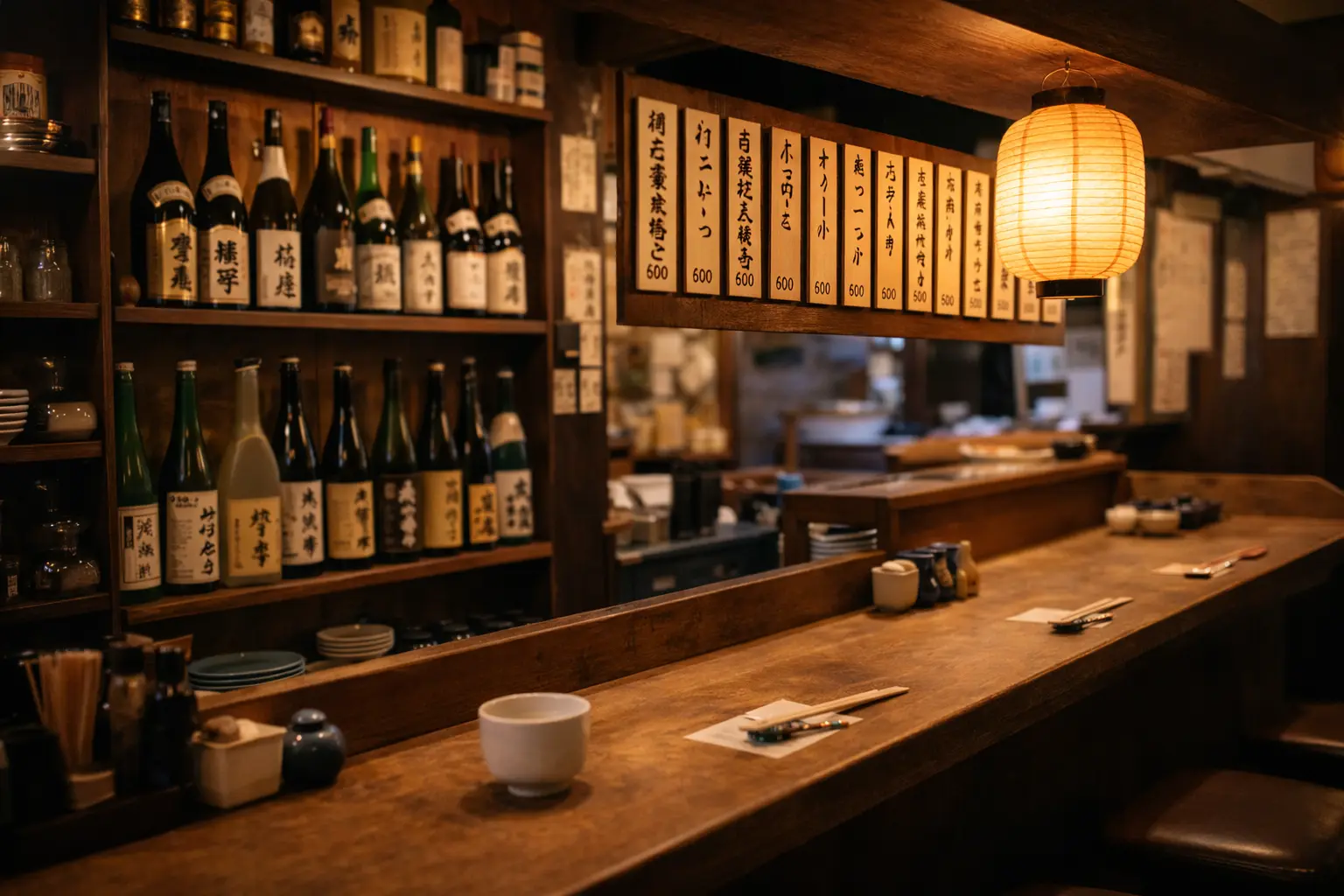
“Dassai Junmai Daiginjo 45 - 1 go - ¥900,” “Shimeharitsuru Jun - 1 go - ¥650,” “Hakkaisan Tokubetsu Honjozo - 1 go - ¥550”—a wall of kanji. I had no idea what any of it meant. I didn’t even know where to start.
My boss casually ordered “Shimeharitsuru, hiya please.” Panicking, I escaped with “Same for me.”
That feeling of defeat that night became my motivation to learn about sake.
Reading the Menu
First, understand the menu structure.
Brand name + Type + Volume + PriceFor example, “Dassai Junmai Daiginjo 45 - 1 go - ¥900”:
- Brand: Dassai
- Type: Junmai Daiginjo 45 (45 is the polishing ratio)
- Volume: One go (about 180ml)
- Price: ¥900
One go is about 180ml—roughly the size of a small beer glass. It usually comes in a tokkuri (ceramic flask).
Two go is about 360ml. It comes in a larger tokkuri or a katakuchi (wide-mouthed pouring vessel).
If it says glass, it’s usually around 90ml. Convenient when you want to try a small amount.
Understanding the Types
You only need to remember this much.
Junmai Daiginjo / Daiginjo—The premium zone. Fruity and fragrant. Order this when in doubt and you won’t go wrong. But it’s expensive.
Junmai Ginjo / Ginjo—The balanced type. You get both aroma and flavor. Good value.
Junmai—Straight-up rice umami. Pairs well with food.
Honjozo—Light and crisp. Doesn’t compete with dishes. Reasonably priced.
The difference between having “junmai” or not is whether distilled alcohol is added. If it says junmai, it’s made only with rice, koji, and water. Neither is better—they just have different flavor profiles.
The Temperature Thing
Sake has different names depending on temperature. This confuses beginners.
Reishu—Chilled from the refrigerator. Around 5-15°C.
Hiya—Here’s where it gets tricky. “Hiya” actually means “room temperature.” Not chilled. The temperature before it goes in the fridge. If you don’t know this and order “hiya,” you’ll be surprised when room temperature sake arrives.
Kan—Warmed. It gets subdivided into “nurukan,” “atsukan,” and “tobikirikan” depending on temperature.
For starters, “reishu please” is the safe choice. The aroma opens up and it’s easy to drink. Warmed sake is a matter of preference—try it once you’re more comfortable.
Actually Ordering
Some phrases for when you talk to the staff.
When you’ve decided: “Dassai, one go, chilled please.”
When you don’t know: “I’m new to sake—which ones are easy to drink?”
Conveying your preferences: “I’d like something fruity.” “I prefer sweet over dry.” “Do you have something that pairs well with tonight’s sashimi?”
No need to be shy. Staff at sake izakayas are usually sake enthusiasts themselves. They’re happy to answer questions.
Use the Tasting Sets
Many izakayas have “nomikurabe sets” (tasting comparisons).
You can try about 3 types of sake in small amounts (usually around 60ml each). Around ¥1,000-1,500 is typical.
These are genuinely useful.
If you order a full go and don’t like it, you’re stuck. But with a tasting set, you can try small amounts and figure out “I like this one” or “this isn’t for me.”
I still start with a tasting set at new places. It gives you a sense of the shop’s selection and style.
Finding Your Own Go-To Bottle
Keep tasting through comparison sets and eventually you’ll meet a bottle that makes you think, “This is the one.” Having a single go-to brand makes izakayas so much more fun.
For me, that’s Hitakami from Miyagi. It’s brewed by Hirataka Shuzo in Ishinomaki, and whenever I spot it on an izakaya menu, I can’t help but order it.
I first met it at a beef tongue restaurant on a trip to Sendai. I opened the menu looking for a drink to go with thick slices of grilled tongue, and there was Hitakami. I tried it, and it went astonishingly well with both the beef tongue and the sashimi. I’ve been hooked ever since.
Hirataka Shuzo is a brewery founded in 1861, and its motto is “If you’re drinking with fish, make it Hitakami!” True to those words, it’s known as a sake that pairs beautifully with seafood.
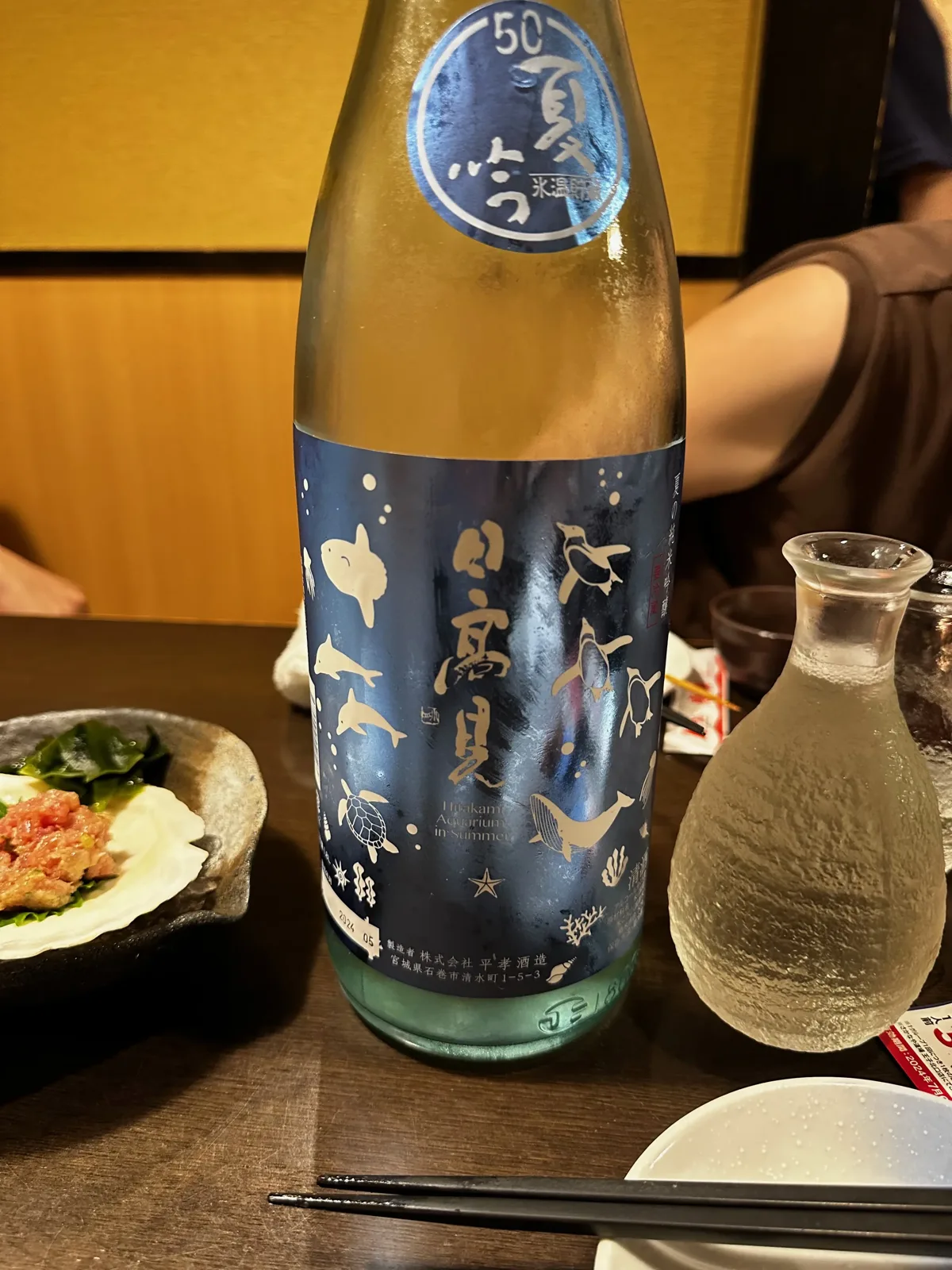
Spotting the seasonal labels at a shop has become one of my little pleasures. The photo shows a Hitakami summer junmai ginjo I ordered at an izakaya one summer—a cool, limited-edition bottle decorated with an aquarium motif that lets you feel the season at a glance.
Once you have a go-to, just seeing a familiar name on the menu at a new place puts you at ease. And that small discovery of “they have Hitakami here too” adds to the pleasure of that one glass. I hope you find your own bottle too.
Pouring Etiquette
There are some manners around pouring at izakayas.
When receiving: Hold your cup with both hands to receive. After they pour, a light bow and “thank you.”
When pouring: Hold the tokkuri with both hands. Pour to about 80% full. Don’t point the spout toward the other person (it’s considered bad luck).
But this is for formal settings.
At casual izakayas, don’t worry too much. No one gets upset if you pour with one hand. What matters is enjoying yourself.
Pairing with Food
Sake is meant to be drunk with meals. It really shines when paired with food.
Sashimi and sushi call for crisp sake. Ginjo or light junmai. It won’t overwhelm the fish. My own go-to, Hitakami, is a bottle I chose precisely for this affinity with seafood.
Tempura pairs with dry sake. It cuts through the oil.
Simmered dishes and hot pot go with warmed sake. Warm food with warm drink.
Yakitori—for salt, something light and clean; for sauce, a full-bodied junmai.
When in doubt, just ask “What goes well with this dish?”
When Things Go Wrong
If you ordered something that doesn’t suit you—it’s okay to leave some.
No need to force yourself. Just try a different brand next time. If you say “This was a bit heavy for me—do you have something lighter?” the staff will happily suggest something else.
If you’ve had too much—ask for water.
“Yawaragi-mizu please” makes you sound like you know your sake. “Water please” is fine too. Nothing embarrassing about it. Drinking as much water as sake is how the pros do it.
Price Guidelines
Here’s the general price range at sake izakayas.
¥400-600 per go—Mostly local sake or honjozo. Good for casual drinking.
¥600-900 per go—Junmai, ginjo. This is the volume zone.
¥1,000 and up per go—Daiginjo, rare brands. For special occasions.
For two people focused on sake with 3-4 dishes, expect around ¥8,000-12,000. Of course, it varies widely by establishment.
Ten Years Later
I go back to that izakaya where I froze—now by myself.
I sit at the counter and ask “What do you recommend today?” The owner says “We just got this one from Niigata.” “I’ll have that.”
It became natural.
No need to overthink it. If you don’t know, ask. If it doesn’t suit you, try the next one. That’s all there is to it.
Sake izakayas aren’t cold places for beginners. They welcome people who are newly interested. Have the courage to say “I’m a beginner.” They’ll be glad to help.
For more about sake, check out Sake for Non-Lovers.