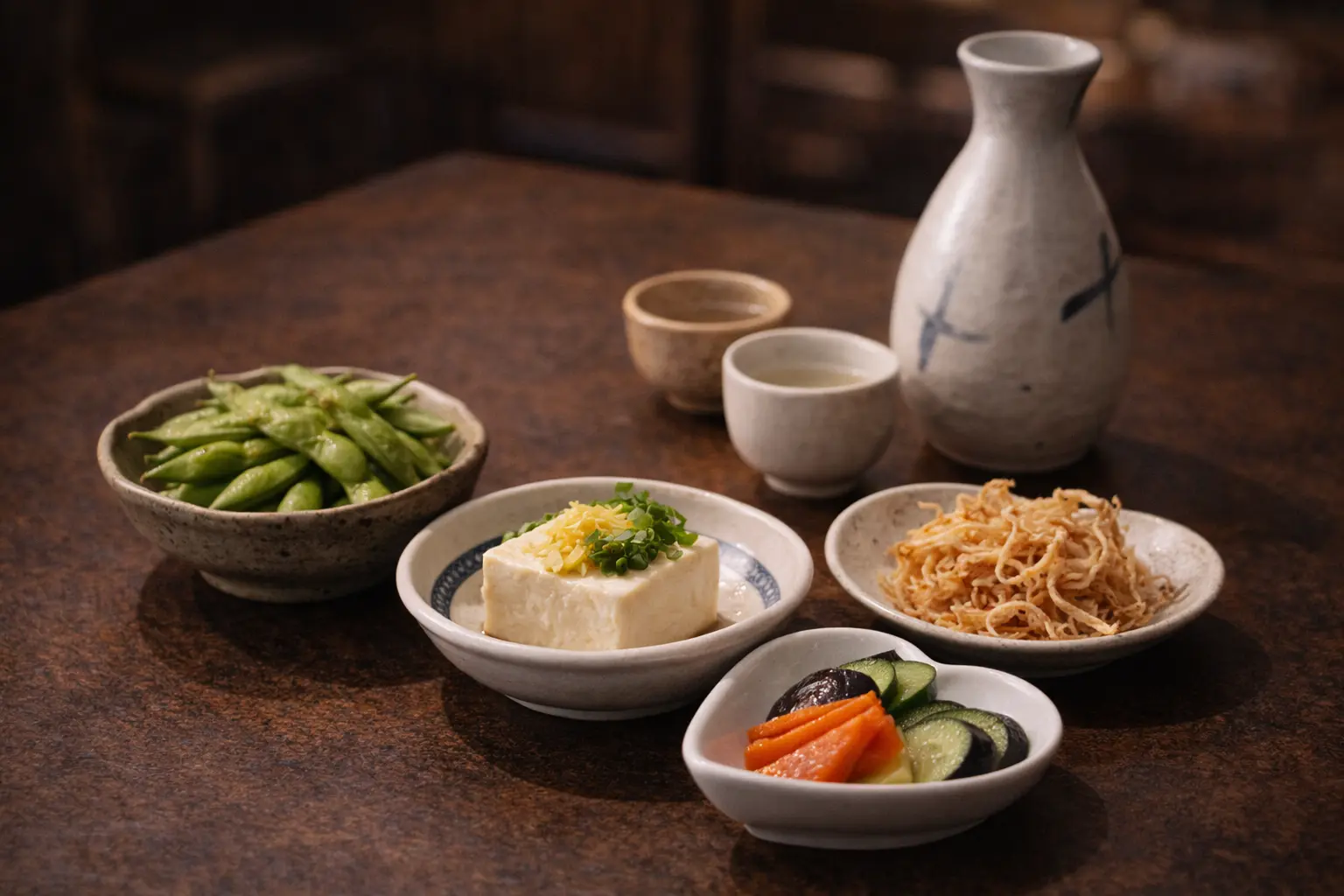
Snacks That Go With Sake: From the Classics to Unexpected Pairings
There are principles behind choosing snacks for sake: layer umami on umami, and match fermented food with fermented drink. Starting from why the three great delicacies—uni, konowata and karasumi—developed for the sake cup, this guide goes all the way to pairings you can build from what is already in your kitchen.
Sake and Snacks: A Moment of Pure Contentment
There is no single correct answer to what you should eat with sake. But there are principles that are hard to get wrong.
And those principles are already embedded, as answers, in Japanese food culture itself. An entire lineage of foods developed for no purpose other than drinking.
The Principle: Layer Umami on Umami
Compared with other brewed beverages, sake contains a large amount of amino acids. These umami compounds are what give sake the thickness of its flavor.
So the basic rule for choosing a snack is simple: match it with something equally rich in umami. When umami meets umami, the flavor is known to expand by more than simple addition.
The other element is saltiness. Salt lifts umami and, at the same time, keeps the sake moving. The reason so many sake snacks are salty is almost certainly that this effect was understood through experience.
Conversely, the difficult partners are strong acidity, strong sweetness, and anything where fat dominates. It is not that they cannot work, but you start having to choose the sake around them.
Chinmi—Foods That Developed for Sake
Japan has a category of foods called chinmi, delicacies. They carry intense umami in tiny quantities, and almost all of them are made by salt-curing or fermentation.
And fundamentally, these developed for the purpose of drinking. They are not something you eat in volume as a side dish with rice; they are meant to be savored in small amounts, almost licked, to carry the sake along.
The Three Great Delicacies of Japan
Since the Edo period, uni, konowata and karasumi have been counted as Japan’s three great delicacies.
Karasumi is mullet roe, salt-cured and dried. It is said to have come to Nagasaki from China in 1652. Sliced thin and lightly seared, its concentrated umami and salt rise up. Its affinity with sake is almost unfair—a single small slice carries a whole cup.
Konowata is sea cucumber intestines, salted and matured. In earlier times, those from Noto, Owari and Mikawa were presented as tribute. It has a distinctive scent of the tide and a dense umami, and is savored in small amounts, melting on the tongue.
Uni here means shio-uni, the gonads mixed with salt into a paste. Those produced in Fukui Prefecture are known as Echizen uni. It is a different thing entirely from the faint sweetness of fresh sea urchin; salt and maturation concentrate the umami.
Shuto
There is one delicacy whose name states its purpose outright: shuto.
It is a salted, long-matured preparation of bonito viscera—chiefly the stomach and intestines. The name comes from the fact that with this as your sakana, the sake keeps disappearing, as though it were being stolen from you (shu = sake, tō = theft).
Its deep umami, built by long maturation, is sometimes compared to anchovy. Serving it with cream cheese, or spooning a little onto cold tofu, has become widespread.
Taste these delicacies and you see the principles of sake snacking made literal. Salty, dense with umami, and a small amount is enough.
Fermented Goes With Fermented
The other major principle is the affinity between fermented foods.
Sake is a fermented food, made by koji and yeast. And the Japanese table is lined with things made the same way—miso, soy sauce, pickles, shiokara, katsuobushi.
Their affinity with sake is no coincidence: they share the fact that amino acids are generated during fermentation. Things made by the same principle sit together at the same table.
Extend the idea and it holds outside Japanese ingredients too. Cheese is fermented milk, and it works extremely well with sake. Aged hard types in particular, and pungent blues, lock into umami-rich junmai and aged sake.
Akita’s iburigakko—a smoked daikon pickle—sandwiched with cream cheese is probably the clearest illustration of the principle. Smoke, the lactic tang of pickling, the umami of cheese: three things layered, finished as a vessel for sake.
Starting With What You Already Have
You do not need to go shopping to have a snack. Sake is perfectly enjoyable with what is already in the house.
Dried things—surume, shredded squid, atarime, nuts. Anything that releases flavor the longer you chew suits an evening of slow drinking.
Canned goods—mackerel in water, seasoned sardines, smoked oysters, corned beef. Canned mackerel in particular becomes a highly accomplished snack simply tipped into a dish.
Refrigerator staples—tofu, natto, kimchi, mentaiko, pickles, cheese. Cold tofu with a few condiments on top is already enough.
From the convenience store—yakitori, oden, cheese kamaboko, boiled eggs, edamame. Oden especially meets sake head-on through the umami of its dashi.
There is also something to be said for not cooking elaborately: it lets you concentrate on the sake itself.
Choosing by Type of Sake
With the four-type classification in mind, the choices organize themselves further.
Kunshu (aromatic and light)—the aroma is the lead, so keep the snack restrained. White fish sashimi, prosciutto, simple cheese, fruit. Strong salt and smoke tend to clash.
Soshu (mild in aroma and light)—the all-purpose type that goes with nearly anything. Edamame, cold tofu, tempura, fried food. It suits everyday snacks best of all.
Junshu (mild in aroma with body)—the territory where the delicacies come into their own. Shiokara, shuto, karasumi, miso-based dishes, simmered dishes, cheese. Warming it opens the range further.
Jukushu (matured and concentrated)—it will not be overpowered by strong flavors. Rich Chinese dishes, eel, blue cheese, dried fruit, chocolate. Surprisingly, it also pairs with sweets.
Changing the Pairing by Temperature
The same snack gives a different impression depending on the temperature of the sake.
For chilled sake, serve cold or light snacks. Sashimi, cold tofu, vinegared dishes, salads. Aligning the temperature range pulls the mouth together.
For warmed sake, serve warm things, or things dense with salt and umami. Oden, hot pot, grilled fish, dried fish, delicacies. Because rising temperature strengthens the perception of umami, a richer snack balances it.
Pair warmed sake with dried fish in winter and you understand, physically, why this combination took hold.
If You Want to Cook a Little
For when you feel like putting in some effort, a few simple things.
Quick-pickled cucumber—slice, sprinkle with salt, let it sit briefly. Mixing in shio-kombu (salted kelp) adds umami.
Grilled miso—mix miso with chopped green onion and shiso leaf, spread it on aluminum foil and grill. The aroma comes up toasty, and a small amount carries the sake.
Avocado dressed with soy sauce—cut it and dress with soy sauce and wasabi, nothing more. The creamy texture suits an umami-rich junmai.
Soy-marinated egg yolk—steep egg yolks in soy sauce overnight. They become a concentrated lump of umami, good eaten straight or over rice.
All of these take a few minutes, and none of the ingredients are special.
If you are ever unsure what to eat with sake, picture something salty, dense with umami, satisfying in small amounts.
The three great delicacies, shuto, iburigakko—all of them meet those conditions. The pairings we have today are the result of drinkers searching in the same direction for centuries.
Canned mackerel and cheese from the convenience store simply sit on the far end of that same line. There is no need to make it complicated.
For pairings with seafood dishes, see Sake and Seafood Pairing.
The characteristics of each sake type are explained in Types of Sake Flavor.
References: Ministry of Agriculture, Forestry and Fisheries, “On ‘uni’, ‘konowata’ and ‘karasumi’, said to be Japan’s three great delicacies”; various publicly available materials on fisheries and food products