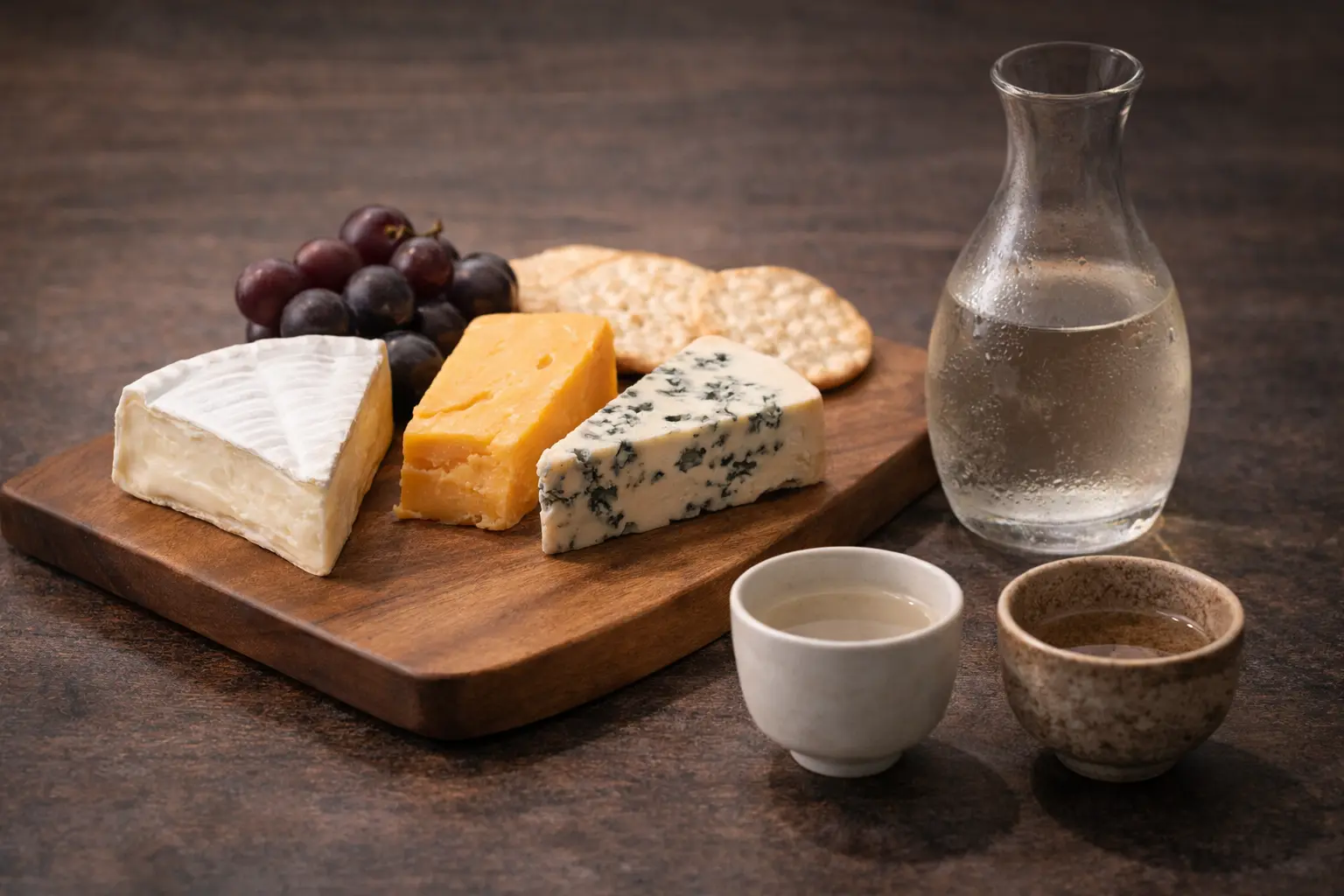
Sake and Cheese Pairing: A Surprisingly Perfect Match
Sake and cheese make an unexpectedly great pair. Discover recommended pairings by cheese type—cream cheese, blue cheese, hard cheese—and why they work so well together.
Sake × Cheese: A Discovery Worth Making
Wine and cheese is a classic pairing. But sake and cheese? Also excellent.
It might seem unexpected. Yet both are fermented products. That common ground creates natural harmony. Try it once, and the compatibility will surprise you.
On this page we go step by step—from the reasons the two work together, to specific pairings by cheese type, to examples you can try tonight with cheese from any supermarket.
Why Sake and Cheese Work Together
Both Are Born from Fermentation
Sake is a fermented beverage from rice, koji, and yeast. Cheese is milk fermented and aged with lactic bacteria and enzymes.
The ingredients are completely different, yet both gain umami and aroma that the raw material never had, through the work of microbes. Because they share this foundation of “flavor made complex by fermentation,” they sit side by side without clashing.
Amino Acids: A Shared Language
During fermentation, proteins break down into amino acids.
The glutamic acid and other amino acids in sake are the source of what we call umami. As cheese ages, its proteins break down too, and amino acid umami builds up. Those white crystals you see on the surface of long-aged hard cheese are crystallized amino acids.
In other words, both speak the same language of umami. So they naturally hold a conversation in your mouth.
Lactic Acid Bridges the Two
The lactic bacteria that ferment cheese produce, as the name suggests, lactic acid. This lactic acid forms part of cheese’s fresh tang and depth.
Sake, too, is a drink where lactic acid plays an important role during brewing. In kimoto-style production especially, lactic acid from lactic bacteria builds the backbone of the flavor. Sake’s moderate acidity and cheese’s lactic acidity share a similar character—another reason the two get along.
Umami × Umami Synergy
It is well known that when two different umami compounds overlap, they intensify not by addition but by multiplication.
When sake’s umami meets cheese’s umami in your mouth, this synergy deepens the flavor dramatically. Together tastes richer and fuller than either alone. The famous wine-and-cheese duo rests on the very same principle.
Cheese-Type Quick-Reference Chart
Start with the big picture. Cheese divides broadly into five types by production and aging. Here is the sake type that tends to suit each.
| Cheese Type | Typical Cheeses | Sake to Pair | Why It Works |
|---|---|---|---|
| Fresh | Mozzarella, cream cheese, ricotta | Nama, ginjo | Bright freshness and light aroma don’t overpower delicate ingredients |
| White-mold | Camembert, Brie | Junmai | Rice’s full umami stands up to creamy richness |
| Blue | Gorgonzola, Roquefort | Sweet, kijoshu | Sweetness gently wraps strong salt and pungency |
| Hard / Semi-hard | Parmigiano, Gouda, Cheddar | Aged sake, honjozo | Aged sake for concentrated umami; honjozo’s crispness for everyday |
| Washed-rind | Époisses, Taleggio | Junmai, aged sake | Bold aroma needs a sake with thick, sturdy umami |
Let’s look at each in detail.
Pairings by Cheese Type
Cream Cheese × Ginjo (Fresh)
For creamy, mild cream cheese, try aromatic ginjo.
Ginjo’s fruity notes enhance cream cheese’s smoothness. An ideal starting point for sake-cheese exploration.
A little black pepper adds another dimension.
Mozzarella × Nama Sake (Fresh)
Fresh mozzarella meets fresh nama sake.
A celebration of freshness. Add tomato and basil for Japanese-Italian fusion caprese.
Camembert × Junmai (White-mold)
White-mold Camembert pairs with rice-forward junmai.
Camembert’s creaminess harmonizes with junmai’s full body. Room temperature or slightly warmed junmai works best.
Blue Cheese × Sweet Sake (Blue)
Strong blue cheese surprisingly pairs with sweet sake.
The sweetness gently embraces blue cheese’s saltiness and funk. Try kijoshu or sweet junmai.
This mirrors a classic wine pairing—noble rot wine with Roquefort.
Parmigiano-Reggiano × Aged Sake (Hard)
Long-aged hard cheese deserves equally aged koshu.
Both concentrate umami over time. Complex flavors resonate together—an adult pairing.
Gouda/Cheddar × Honjozo (Semi-hard)
Rich semi-hard cheese matches clean honjozo.
Honjozo’s crispness refreshes after cheese’s richness. An easy, everyday pairing.
Washed-rind Cheese × Junmai (Washed-rind)
Washed-rind cheeses, aged with their surface washed in brine or spirits, have a strong, distinctive aroma.
That intense aroma calls for a junmai or aged sake with thick umami. A light sake gets overwhelmed, so meet it with something sturdy.
Start with Cheese You Can Easily Find
You don’t need a specialty shop—cheese from your local supermarket is plenty. Begin with these three.
Camembert
Buy one box and it lasts several days—the archetypal white-mold cheese. Leave it out of the fridge for about 15 minutes, and when it starts to soften, pair it with junmai. Slice it, serve as is. That alone makes a proper little plate.
Mozzarella
Mild and easygoing, it works with almost any sake. Tear it into bite-size pieces, dress with olive oil and salt, and serve with chilled nama or ginjo. Add tomato for color.
Parmigiano-Reggiano
Buy a block and break it into shards with a knife. The deep umami that spreads as you chew resonates beautifully with aged sake or warmed junmai. Satisfying in small amounts, and it keeps well.
Tips for Enjoyment
Match Temperatures
Cold cheese with cold sake, room-temperature cheese with room-temperature sake.
Similar temperatures create better integration. Though blue cheese with sweet sake often works better with slightly chilled sake.
Start Small
No need to buy large cheese portions initially.
Small supermarket cheeses work fine. Try various types in small amounts to find your preferences.
Add Twists
Plain cheese is great, but small additions enhance things.
- Cream cheese + soy sauce
- Camembert + miso
- Gouda + wasabi
Japanese seasonings improve sake compatibility further.
Check Cheese Condition
Cheese flavor changes with temperature.
Better flavor emerges when slightly warmed from refrigerator cold. Take it out 15-20 minutes beforehand.
Unexpected Combinations
Sake Lees Cream Cheese
Mix cream cheese with sake lees for dramatically improved sake compatibility.
Simple to make: equal parts cream cheese and sake lees. A pinch of salt helps too.
Smoked Radish + Cream Cheese + Sake
Iburigakko (Akita’s smoked pickled radish) with cream cheese. Add sake, and it’s perfection.
Smoky aroma, creaminess, sake’s crispness. Trinity of deliciousness.
Miso-Marinated Cheese
Marinating cheese in miso creates Japanese-style fermented snacks.
Bury cream cheese or mozzarella in miso for 1-2 days. Guaranteed junmai compatibility.
Different from Wine
Sake’s Advantages
Some wines have strong tannins or acidity. They can clash with cheese fat.
Sake is generally smoother. Less conflict with cheese, more versatile pairing options.
Unexpected Versatility
Sake might seem “Japanese food only.”
Actually, it pairs well with fermented foods broadly. Beyond cheese—prosciutto and salami too. Having sake as a wine alternative expands your options.
Frequently Asked Questions
How is this different from wine-and-cheese pairing?
The biggest difference is that sake has almost no tannin. Wine’s astringency can clash with cheese fat, but sake is mellow and gentle on the palate—so it accommodates a wide range of cheeses. Sake also leads with sweetness and umami more than wine does, making it easy to cradle strongly salted cheeses. If wine pairing is about enjoying contrast, sake pairing is about enjoying harmony. That framing makes it easier to understand.
Which combination should a beginner start with?
Cream cheese with ginjo, or Camembert with junmai. Both cheeses are mild, so the effect of the sake’s aroma and umami comes through clearly. A small cheese from the supermarket and a bottle of sake you already enjoy is all you need. Experience the “surprisingly good match” with this first plate, then move on to bolder characters like blue and washed-rind cheese.
What temperature should I serve them at?
The basic rule is to bring the cheese and sake close in temperature. Chilled fresh cheese with cold sake; hard cheese returned to room temperature with room-temperature or warmed sake—matching them creates a sense of unity. When in doubt, take the cheese out of the fridge for 15-20 minutes to reach room temperature, and serve the sake slightly chilled; that rarely goes wrong. Since the same pairing changes character with temperature, adjusting as you drink is part of the fun.
How do I choose a sake when I don’t know the labels?
There’s no need to gather many types. Start by picking one junmai. Junmai has solid rice umami and a broad range—it can hold its own against everything from white-mold to hard and washed-rind cheese. Add one light ginjo or nama for fresh cheese, and you’ll cover most combinations.
When reading the label, first check the category—“junmai,” “ginjo,” and so on. If there’s a sweet/dry indication or a sake meter value (SMV: plus means drier, minus means sweeter), lean toward a sweeter one for blue cheese. That level of guidance is plenty. Don’t overthink it—just start with a bottle you already enjoy.
Summary
Sake and cheese—worth trying.
Fermented food affinity, umami synergy. The theory makes sense, but just try it. New discoveries await.
Tonight’s drink with a piece of cheese. That’s all it takes to expand how you enjoy sake.
Learn more about sake pairing in Sake and Meat Pairing.