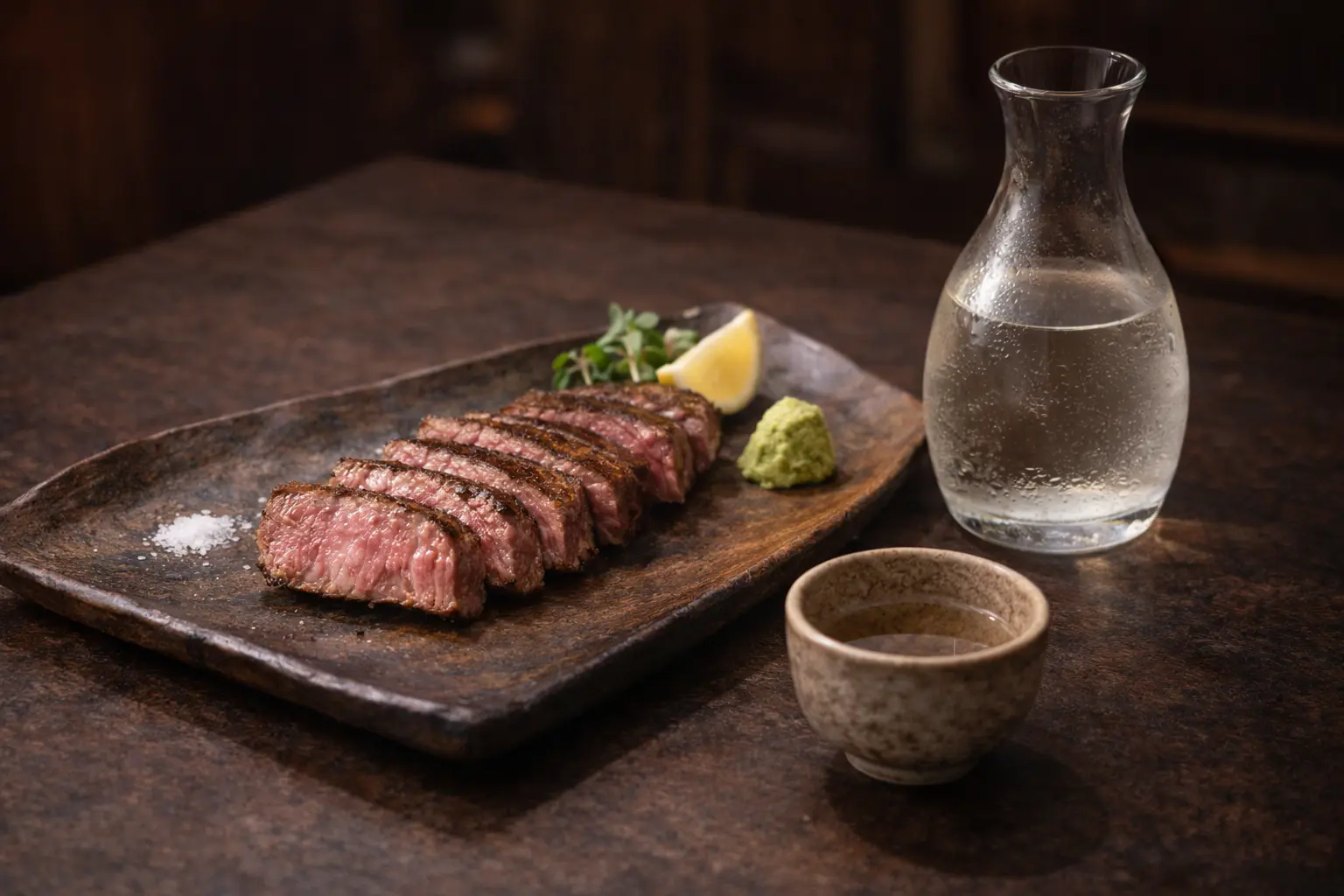
Sake and Meat: Pairing with Yakiniku, Steak, and More
Sake pairs excellently with meat dishes. Learn how to match sake with yakiniku, steak, shabu-shabu, and yakitori based on meat type and cooking method.
Sake with Meat: A Choice Worth Making
Beer with yakiniku, red wine with steak—classic pairings.
But sake works too. Actually, it works wonderfully. It enhances meat’s umami, cleanses the palate of fat, makes the next bite delicious. Sake and meat—worth trying.
This page walks through it in order: first the reasons why the pairing works, then how to match specific meats and cooking methods, and finally how to put it into practice at everyday meals like yakiniku or a Sunday roast. By the end, you’ll have your own framework for choosing the next bottle.
Why Sake Works with Meat
Start with the theory. Once you understand why it works—rather than “it just kind of does”—you can choose confidently, whether at a restaurant or at home.
Umami Synergy
Meat contains abundant inosinic acid. Sake has plenty of glutamic acid.
In the world of umami, these two are a famous duo. Inosinic acid and glutamic acid register as far more savory together than either does alone. It’s the same principle behind Japanese dashi, where kombu (glutamic acid) and bonito flakes (inosinic acid) combine into a broth deeper than the sum of its parts—and it works between meat and sake too.
Take a bite of meat, let the umami spread, then sip sake, and the savoriness swells another notch. It’s a “building umami” direction of pairing that beer’s carbonation or wine’s tannin simply can’t offer.
Cutting Through Fat
Sake has moderate acidity. And the alcohol itself helps dissolve fat.
Eat rich, fatty meat continuously and a film of fat coats your mouth, dulling your sense of taste. Here sake’s acidity and alcohol wash that film away and reset the palate. That’s why the next bite tastes as good as the first. It’s part of why yakiniku keeps going and going.
Every drink “cuts fat” differently: beer pushes it away with carbonation, wine severs it with acid and tannin. Sake lifts the fat cleanly while leaving umami behind—and that balance is exactly why it suits meat.
Neutralizing Gaminess
Sake’s alcohol and organic acids soften meat odors—the same reason cooking sake is used to prep meat.
It’s especially good with lamb and game. The gaminess fades, letting the meat’s true flavor step forward.
The Effect of Temperature
Sake can be served chilled or warmed. This range widens its compatibility with meat even further.
Chilled, its acidity and crispness sharpen, working to cut through fat. Warmed, its aroma and umami expand, leaning into the sweetness of braises and hot pots. The same bottle plays a different role at a different temperature. Choosing the serving temperature to match how the meat is cooked is the hidden key to pairing.
Meat × Cooking Method: Quick Reference
A cheat sheet for when you’re unsure—“for this dish, this type, at this temperature.” Treat it as a starting point and adjust toward your own taste from there.
| Dish | Sake Type | Recommended Temp |
|---|---|---|
| Yakiniku (kalbi, harami) | Robust junmai | Chilled–room temp |
| Steak (sirloin) | Yamahai/kimoto junmai | Room temp |
| Sukiyaki | Crisp honjozo | Room temp–warm |
| Pork shabu-shabu | Aromatic ginjo | Chilled |
| Braised pork belly | Full-bodied junmai | Room temp–warm |
| Tonkatsu | Sharp honjozo | Chilled |
| Yakitori (salt) | Delicate ginjo | Chilled |
| Yakitori (sauce) | Umami-rich junmai | Room temp |
| Karaage | Crisp honjozo | Chilled |
| Lamb | Distinctive yamahai junmai | Room temp |
| Venison/boar (game) | Aged koshu | Room temp–warm |
The temperature logic is simple. When you want to cut fat or lighten fried food, go chilled. When you want to savor umami fully, go room temperature. For sweet braises and winter hot pots, go warm to hot. Remember these three options and you can handle almost any meat dish.
Pairings by Meat Type
The cheat sheet, in a little more detail—with the reasoning behind each match.
Beef
Yakiniku × Junmai
For fatty cuts like kalbi or harami, try robust junmai.
Junmai’s body matches meat’s richness. Acidity refreshes the palate—you keep eating. Room temperature for sauced yakiniku; chill it slightly for cuts eaten with salt or lemon to cut the fat harder.
Steak × Yamahai/Kimoto
For sirloin or ribeye, try powerful yamahai or kimoto junmai.
Yamahai and kimoto are built on lactic-acid-driven, full-bodied acidity and depth, letting them stand toe-to-toe with the heavy flavor of red meat. A worthy substitute for wine. Aged meat with aged sake is worth exploring too.
Sukiyaki × Honjozo
For meat in sweet-savory broth, try crisp honjozo.
The sauce’s sweetness and honjozo’s finish pair well, and it catches the mellowness of the beaten-egg dip. Warmed gently, it satisfies even more.
Pork
Pork Shabu-shabu × Ginjo
For light shabu-shabu, try aromatic ginjo.
Pork’s sweetness and ginjo aromatics match elegantly. With ponzu sauce, serve it chilled to bring out the acidity.
Braised Pork Belly × Junmai
For rich braised pork, try full-bodied junmai.
Junmai’s umami embraces the melting, fatty sweetness. Room temperature or slightly warm, leaning into that sweetness.
Tonkatsu × Honjozo
For crispy tonkatsu, try sharp honjozo.
It cuts through fried oil cleanly. Beer’s good, but try sake too—chilled is best.
Chicken
Yakitori (Salt) × Ginjo
For simple salt-grilled skewers, try delicate ginjo.
Chicken umami and ginjo aromatics harmonize. Especially good with tender or breast meat.
Yakitori (Sauce) × Junmai
For sweet-savory sauce, try umami-rich junmai.
Sauce sweetness and junmai richness resonate. Great with thigh and skin.
Karaage × Honjozo
For juicy fried chicken, try crisp honjozo.
It cleanses the oil—you can eat endlessly. With lemon, serve sake chilled.
Lamb and Game
Lamb × Yamahai Junmai
For gamey lamb, try equally distinctive yamahai junmai.
Both personalities meet, creating unique harmony. Gaminess becomes less noticeable.
Venison/Boar × Aged Sake
For wild game, try aged koshu.
Complex flavors resonate together. Ask for sake at restaurants serving game.
Putting It into Practice
You’ve got the theory and the cheat sheet. Now it’s just a matter of trying it at the table. Here’s how it plays out in three common scenes.
Around the Yakiniku Grill
Your first glass can be beer, that’s fine. From the second, switch to sake.
For the early lean cuts and salted tongue, go chilled junmai or a dry style. As you move to fattier kalbi and premium harami, switch to a robust junmai at room temperature. When the fat starts to feel heavy, drop back to chilled—just shifting temperature back and forth keeps you eating happily to the end. Sauced cuts pair beautifully with an umami-rich junmai.
Enjoying Sukiyaki
Sukiyaki stars its sweet-savory broth and the mellowness of the beaten-egg dip.
What you want here is a crisp honjozo or a clean junmai. It’s delicious chilled, but warmed to match the steam of the pot, the broth’s sweetness and the sake’s umami become one. A useful rule: with sweet dishes, meet them with crispness rather than trying to out-sweeten them—that keeps the balance.
A Casual Night with Karaage
The home-drinking staple: fried chicken. For its heat and oil straight from the fryer, a crisply chilled honjozo or dry junmai is the perfect partner.
One bite, wash it down clean with sake, and another. When you squeeze on lemon, the sake’s acidity answers back. The same approach carries straight over to gyoza, kushikatsu, and other fried or batter-based bites.
Temperature Selection
Let’s lay out the temperature choices once more. That a single sake changes character with temperature is one of the most fascinating things about it.
Chilled
For fatty meats and fried foods. Cold sake refreshes; acidity and crispness sharpen, strengthening its fat-cutting power.
Room Temperature
For savoring meat’s umami fully. Both meat and sake taste best here, and the umami synergy comes through most naturally.
Warm
For winter hot pots and braised dishes. It warms the body and aids digestion; aroma and umami expand to lean into sweet broths and rich seasoning.
Sake at Meat Restaurants
A few small tips for ordering out.
Yakiniku Restaurants
More yakiniku spots now stock sake, as owners come to recognize how well fat and sake go together. If it’s on the menu, try it. Say “a robust junmai for fatty meat” and they’ll usually pour you something good.
Steakhouses
Some list sake alongside their wines. Ask the sommelier for a sake that pairs with beef—it’s a fine move.
Yakitori Shops
Yakitori and sake are already a classic. Switching sake between salt and sauce is the connoisseur’s way to enjoy it.
Frequently Asked Questions
Q. Can sake replace red wine with steak?
Yes. Yamahai and kimoto junmai in particular have a lactic-acid-driven, full-bodied acidity and depth that hold up to the heavy flavor of red meat. An aged koshu leans into hefty cuts even more. The direction differs from red wine’s tannic grip—sake’s way is to add umami while cutting the fat. Room temperature is the recommendation.
Q. How do I handle the distinctive aroma of lamb or game?
The rule is to meet character with character. Pair lamb with a distinctive yamahai junmai, and venison or boar with an aged koshu. Sake’s alcohol and organic acids soften the gaminess while its own complex aromas stand as equals to the meat’s wildness. A quiet, light-and-dry sake tends to get overrun by the meat, so choose one with real personality.
Q. Rich meat keeps piling up and feels heavy. How do I keep it light?
Serving chilled is the quickest fix. Lowering the temperature sharpens acidity and crispness, strengthening the fat-cutting power. A dry junmai or honjozo served cold resets the mouth so the fat feels less heavy. For cuts eaten with salt or lemon, this combination works especially well.
Summary
Meat and sake—better than you’d expect.
Umami synergy, fat-cutting acidity and alcohol, gaminess neutralized—and temperature to fine-tune it all. The theory supports sake-meat pairing.
Next yakiniku or steak night, reach for sake instead of beer or wine. Keep the cheat sheet handy, play with the temperature, and see what you discover.
Learn more about sake pairing in Sake and Western Cuisine.