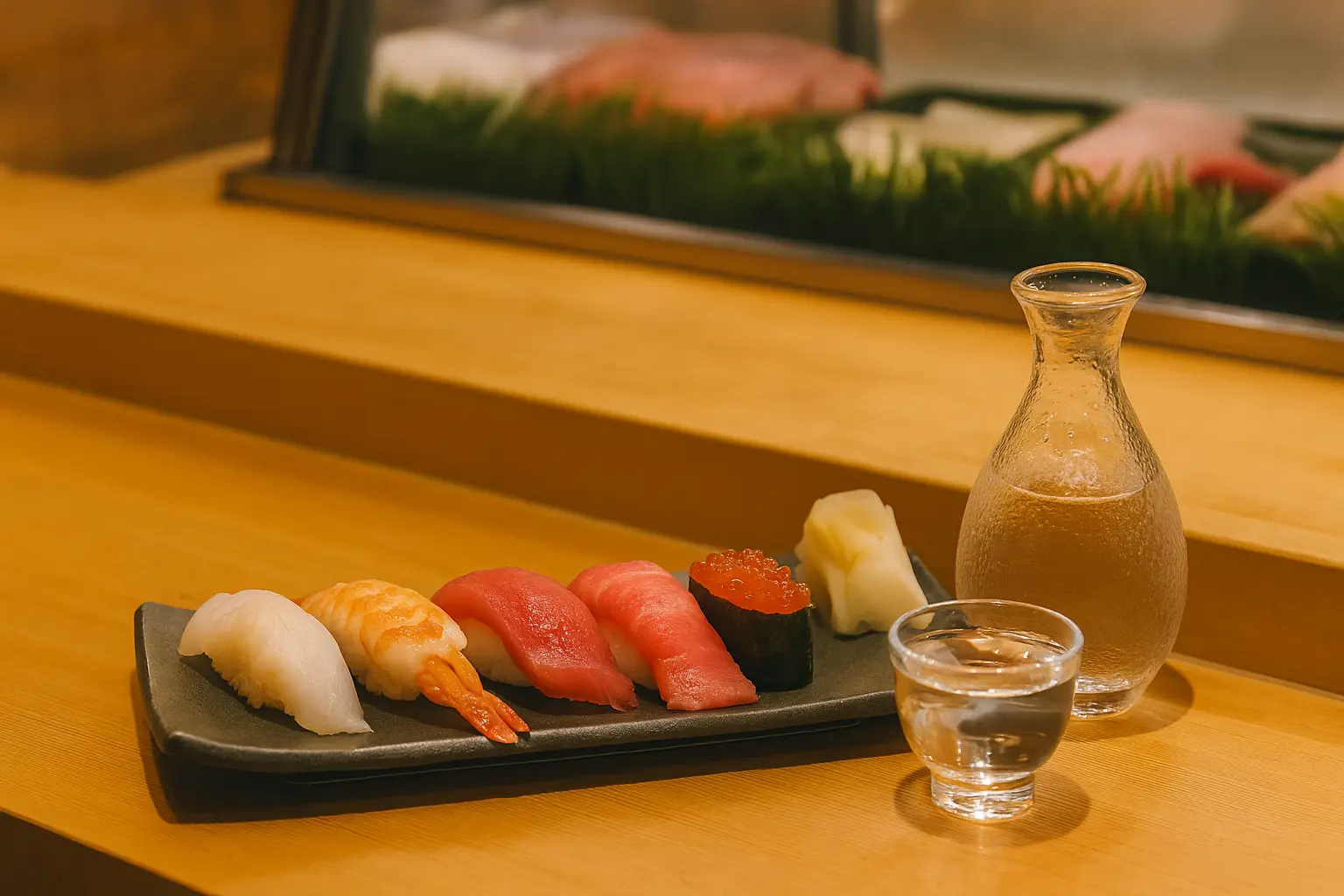
Sake at the Sushi Counter: Etiquette, Ordering, and the History Behind the Pairing
The kasuzu vinegar that gave Edo-style sushi its character was made from sake lees. This article traces the shared fermentation lineage of sushi and sake, then covers how to order at the counter, what to pour with each topping, and the etiquette worth knowing.
Sake at the Sushi Counter
Ordering sake at a sushi counter feels so natural that most people never stop to ask why the two belong together.
But the relationship runs deeper than taste. Sushi and sake are linked by history. Both were born from rice and fermentation, and the vinegar that carried Edo-style sushi through its golden age was made from the sake lees left behind after brewing.
Before turning to flavor, it is worth following that lineage.
Sushi Began as a Fermented Food
The ancestor of sushi is narezushi, or “matured sushi.” Fish was packed with salt and cooked rice and left to undergo lactic acid fermentation over many months. The funazushi of Shiga Prefecture preserves this form today.
In that process, rice was merely the medium for fermenting the fish. As fermentation advanced the rice broke down into a paste, and only the fish was eaten. The rice was thrown away.
By the Muromachi period, a version called namanare appeared, in which fermentation was halted partway so that the rice could be eaten as well. Later still came a new idea: rather than waiting for fermentation, use vinegar to supply the acidity. This was hayazushi, the direct ancestor of today’s vinegared rice.
Then, in the late Edo period during the Bunsei era (1818–1831), nigirizushi took its finished form. Hanaya Yohei of Ryogoku is remembered as the figure who brought it together. Months of fermenting fish were replaced by an instant of vinegar — the history of sushi is, in large part, a history of that compression.
One phrase deserves a second look here: lactic acid fermentation. Kimoto, the traditional method of building a sake starter, also relies on lactic acid bacteria to suppress unwanted microbes. The principle used to preserve fish and the principle used to brew sake safely are one and the same.
The Vinegar in Sushi Rice Came from Sake Lees
What sealed the bond between sushi and sake was kasuzu (sake lees vinegar).
In 1804, Nakano Matazaemon of Handa in Owari Province (present-day Handa, Aichi) traveled to Edo and encountered the hayazushi then in fashion. The sushi of that era used rice vinegar. It occurred to him that swapping rice vinegar for a vinegar made from sake lees might yield something better.
Back in Handa, Matazaemon set to work and produced a vinegar brewed from aged sake lees. Because it gave the rice such a beautiful color, the vinegar was named Yamabuki — the first product of the brand known today as Mizkan.
Kasuzu was deeper in umami and mellower than rice vinegar. Sushi shops across Edo adopted it, and it traveled from the port of Handa to the capital aboard bezaisen (coastal cargo ships). This family of vinegar, still called akazu (red vinegar), defined both the color and the flavor of Edo-style sushi.
Which is to say: Edo-style sushi was sustained by a byproduct of sake brewing. The lees pressed out of the sake tank became the foundation of the sushi rice itself.
Drinking sake at a sushi counter, then, closes a circle that begins at the level of raw ingredients.
Why They Work Together on the Palate
Setting history aside, the practical affinity is worth examining too.
Umami synergy. Seafood is rich in inosinic acid; sake carries amino acids. When these different umami compounds meet, the perceived umami is known to rise beyond simple addition. Sake contains more amino acids than most other brewed beverages, which makes it an easy partner for fish.
Fishy odors stay quiet. The off-smell of fish intensifies on contact with iron. Sake contains extremely little iron: brewers rigorously exclude it because it damages both flavor and color, and the result is a drink that does not draw out fishiness when paired with fish.
It resets the palate. A sip of sake after the acidity of the rice and the fat of the fish resettles the tongue for the next piece. Given that sushi arrives one piece at a time, this role is not a minor one.
How to Order at the Counter
The First Glass
Right after you sit down, a clean, chilled sake is the easiest choice. A light junmai or honjozo, served cold. Since you have not eaten anything yet, avoid anything with an overwhelming aroma or flavor.
Opening with a daiginjo can mean the sake overpowers the delicate toppings that come early in the meal.
Follow the Progression of the Toppings
White fish first, then red flesh, silver-skinned fish, shellfish, and finally simmered conger eel and egg — sushi generally moves from light to rich. Move the sake in the same direction and the two stay in step.
- White fish and squid — light chilled sake, restrained in aroma
- Akami and chutoro tuna — junmai with good umami; room temperature also works
- Silver-skinned fish (kohada = gizzard shad, aji = horse mackerel) — sake with acidity, enough to stand up to the vinegar cure
- Shellfish (akagai = ark shell, hotate = scallop) — aromatic ginjo styles that echo the shellfish sweetness
- Uni (sea urchin) and ikura (salmon roe) — either a rich junmai to meet them head-on or a light sake to rinse them away; opinions divide
- Anago (conger eel) and egg — for the sweet glaze, a sake with umami served as warm nurukan
Detailed pairings with seafood in general are covered in Sake and Seafood Pairing.
How Much to Order
At a sushi restaurant, small pours of several different sake suit the meal best. Ordering half a go of a few varieties tracks the progression of the toppings better than working through a full go of one.
If the shop sells by the glass or by the half-go, take advantage of it. Many will bring out a fresh vessel each time you change labels.
What to Say
“Whatever you recommend” will do, but a little specificity sharpens the result.
“I’m having kohada next — something that goes with it, please.”
Framing the request around the topping is the most natural way to ask at a sushi counter. The chef knows their own sushi better than anyone, and a question posed this way gets a precise answer.
Counter Etiquette
There is no need to be stiff about it, but a few things make it easier to settle in.
Mention things when you book. Toppings you dislike, allergies, how long you can stay. The more the shop knows in advance, the better it can plan. Saying that you would like to drink sake is worth doing too — some chefs will build the course with that in mind.
Eat the nigiri promptly. Each piece is formed at the moment when the temperature of the rice and the condition of the topping are ideal. If you are photographing it, be quick. Even mid-conversation, it makes sense to turn to the sushi the moment it is set down.
Fingers or chopsticks, either is fine. Neither is incorrect. If you eat with your hands, use the oshibori towel each time.
Gari is a palate cleanser. Eat as much as you like, but its purpose is to reset the palate, so small amounts between pieces is how it is meant to be used.
“Agari” and “shari” are really shop-side words. It is not rude for a customer to use them, but there is no need to force it. “Green tea, please” gets the point across perfectly well.
Skip strong fragrance. It masks the delicate aromas of the fish, and it is a courtesy to the person seated next to you as well.
At Standing Bars and Conveyor-Belt Shops Too
None of this is limited to high-end counters.
Standing sushi bars and regional conveyor-belt shops increasingly stock local sake. In port towns especially, the fish landed nearby and the sake brewed nearby may be available at the same counter. Matching a drink to its region is easiest to put into practice at exactly these places.
Choose a glass that suits the fish in front of you, without ceremony. Do that, and the class of the establishment stops mattering.
The relationship between sushi and sake is not fully explained by the phrase “good pairing.”
It begins with fermenting fish in rice, compresses that time with vinegar, and that vinegar was made from sake lees — the history of sushi crosses the technology and the raw materials of sake again and again.
When you alternate a piece and a sip at the counter, two centuries of accumulation are riding along.
For pairing with seafood dishes in general, see Sake and Seafood Pairing.
Tips on ordering at restaurants are also covered in How to Order Sake at an Izakaya.
References: Mizkan, “Sushi Lab: The History of Sushi”; Mizkan Holdings, “Nakano Matazaemon I”; publicly available materials on the formation of Edo-style sushi