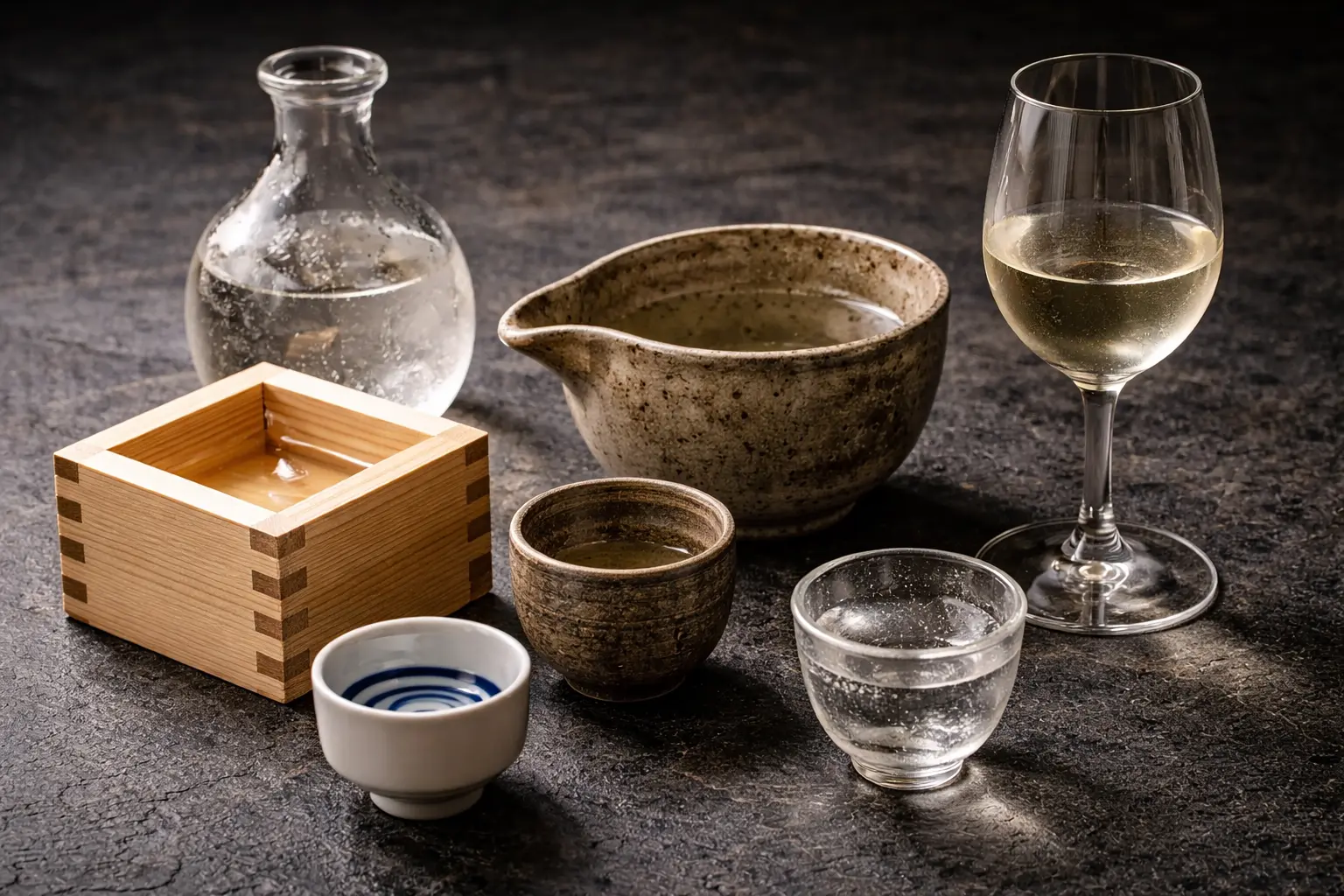
Choosing Sake Vessels: Ochoko, Guinomi, Wine Glasses
How to choose the right vessel for better sake enjoyment. From ochoko and guinomi to wine glasses, learn how materials and shapes affect flavor.
How Vessels Change Sake’s Taste
Poured from the same bottle, sake can taste noticeably different depending on the cup you drink it from.
It’s a difference many drinkers first notice by accident—say, an evening when the usual guinomi is in the sink and a thin glass tumbler has to stand in. The aromas rise in a completely different way. It hardly seems like the same sake—the edges feel sharper, the whole thing colder. A moment like that makes it click: a vessel is not merely a container for sake but a device that shapes the flavor itself.
How the aroma is carried to your nose, where the liquid lands on your tongue, how much warmth or chill the vessel can hold—each of these depends on the cup’s rim width, depth, thickness, and material. So in this piece I want to pick up the vessels one by one, as if turning each in my hand, and follow what their shapes and materials are actually doing to the taste.
The Ochoko, Where It Begins
Let’s start with the ochoko—that small cup most people picture when they think of sake.
The essence of the ochoko is its smallness. You finish it in one or two sips, which means you drink warm sake before it cools and chilled sake before it turns tepid, always at its best temperature. Pour and sip, then pour again. Through this short rhythm the sake stays perpetually fresh. The ochoko became the vessel of izakaya and banquets because its size fits so naturally with the culture of pouring for one another. Someone fills your cup, and you fill theirs. As the vessel of that gesture, the ochoko is just the right size.
Many ochoko are given a gentle roundness toward the middle, and there is a reason for it. Aroma gathers for a moment inside that tapered space and drifts up as you bring the cup to your lips. Rather than broadcasting the scent, the ochoko offers a concentrated note with every sip. That is simply how this cup works.
Guinomi—Sharing Temperature in the Hand
A size larger than the ochoko, fitting snugly in the palm, is the guinomi.
The name is said to come from gui to nomu, “to gulp down,” but in truth this cup is made for drinking slowly. Its extra capacity lets you stay with a single pour longer. Cradle it in your whole palm and a warm sake passes its heat to your hand, a chilled one returns a cool touch. The temperature of the vessel and the temperature of your hand move back and forth—that intimacy is the charm of the guinomi.
Its range of materials is wide too—ceramic, porcelain, glass—and many people collect one-of-a-kind pieces by individual artists. A tool for drinking that also rewards you simply lined up on a shelf: the cup itself becomes a small work of art. Searching for the one that fits your hand is, in itself, a doorway into the pleasure of sake.
The Hirasakazuki—Opening the Aroma, Tasting the Finish
Among sakazuki, the wide, shallow ones are called hirasakazuki, and their character is distinctly different from the ochoko or guinomi.
The shallow, open form spreads the sake thinly and widely across the tongue. Because the whole tongue receives it, you pick up richness and body more readily. At the same time, aroma disperses freely from the broad surface. Where the ochoko hoards its scent, the hirasakazuki opens it up and lets it go. Holding nothing back, the finish stays light and clean. It suits a calm junmai, or an aged koshu you want to savor quietly.
The thinness of the rim matters too. A thin rim meets your lips sharply and makes the sake’s attack feel crisp; a thick rim is softer and rounder in the mouth. Even within the same hirasakazuki, the making of the rim alone changes how the sake enters. Vessels are not to be underestimated.
Katakuchi and Tokkuri—Vessels of the Pour
Where there are cups for drinking, there are vessels for pouring. The katakuchi and the tokkuri shape the time before the sake reaches your lips.
The katakuchi is a bowl-like vessel with a spout formed on one side of the rim. You decant chilled sake into it, set it on the table, and pour from there into ochoko or guinomi. Exposing that broad surface to the air lets the edges of a young sake soften a little and the aroma open. A glass katakuchi lets you enjoy the sake’s color, a ceramic one the feel in your hand. The very act of pouring a thread of sake from the spout enriches the wait for a cup.
The tokkuri is the partner of warm sake. That narrow-necked, round-bodied shape is not made of appearance alone. The slender neck slows the warmed sake from cooling, and the swelling body helps the heat of the bath reach the sake. A form that makes sense has become, in the same stroke, a beautiful one. Lifting a water-warmed tokkuri and pouring in a steady trickle into an ochoko—it is this whole sequence that completes the comfort of kanzake.
Masu—The Scent of Wood and the Memory of Celebration
Sake drunk from a masu of cypress or cedar takes on the aroma of the wood.
Opinions on that scent divide; some feel it covers the sake’s own fragrance. And yet the masu has kept its place at celebrations for a reason beyond aroma. The masu, once a box for measuring rice, echoes the word masu meaning “to increase,” and so it became a token wishing that prosperity and happiness may grow. In the way of drinking—a little salt mounded on one corner, lips to the edge—the clean scent of wood and the mood of celebration melt into one. It is a cup less for the everyday than for the turning points.
Wine Glasses—Chasing the Ginjo Aroma
It may come as a surprise, but aromatic ginjo and daiginjo pair beautifully with a wine glass.
Inside the rounded bowl the aroma gathers for a moment, then rises toward the tapered mouth. Tilt the glass and bring your nose close, and the lush ginjo scent travels straight into your nasal passage. The more a sake casts its floral or fruit-like aroma as the lead, the greater the benefit of this shape. In recent years glasses have been designed for sake specifically, tuned in the width of the mouth and the length of the stem, and drinking to chase the aroma has taken root as a style of its own.
The flip side is that a shape built to lift aroma is poor at holding temperature. The large bowl exposes the sake to air, so the temperature shifts easily; when you want to keep the chill, it helps to pour a modest amount. To draw out a vessel’s strength, it never hurts to know its weakness too.
Pewter—The Metal That Dissolves the Edge
Metal cups may sound cold, but pewter (tin) has long been a fine supporting player among sake vessels.
It conducts heat well: warm it and it heats at once, chill it beforehand and it keeps cold sake cold. It is an honest material about temperature. More than that, tin has a strong ionic effect, said to act on the fusel oils—volatile compounds born during brewing—and soften the edges of the sake. The sharp rough notes are drawn off and the mouthfeel turns mellow. This very action is surely why pewter has been loved by sake drinkers for so long.
Osaka’s pewter craft flourished around Shinsaibashi in the early Edo period and still accounts for much of the country’s production; in 1983 it was designated a national traditional craft. Because tin is a soft metal, difficult to machine, most steps from casting to polishing rely on the hands of craftsmen. The muted luster that deepens with use is itself a flavor born of that handwork.
Kiriko and Japanese Glass—Coolness You Drink With Your Eyes
For chilled sake in summer, glass vessels are the natural choice. Clear sake catches the light and lets you feel the coolness with your eyes.
Edo kiriko in particular cuts patterns into color-overlaid glass, showing many faces as it catches the light. Pour in a crystal-clear ginjo or a fresh shiboritate namazake and the purity of the sake and the sparkle of the cuts answer one another—a pleasure for the eyes before the first sip. Tsugaru bidoro, a Japanese glass from Aomori, is blown one piece at a time, so no two are ever alike. Vivid colors evoking Aomori’s four seasons or its Nebuta festival make the crisp taste of chilled sake feel all the cooler. The thin rim of glass keeps the mouthfeel delicate and suits a cup with ice floating in it. Few materials let you enjoy so plainly the pleasure of “drinking while gazing.”
Ceramic and Porcelain—Earthy Warmth, White Sharpness
To continue with materials, the difference between ceramic and porcelain is worth touching on.
Ceramic, made from earth, conducts heat poorly and holds warm sake warm for you. Its rough surface makes the sake feel mellow, and the warmth of the clay in your hand somehow settles the mind. Bizen, Shigaraki, Hagi—each region has its own texture, and it is uniquely ceramic that the piece “grows” as it drinks in the sake, its color and surface maturing with use. Into a long-companioned cup, even the memory of the nights you drank seeps in.
Porcelain, by contrast, is thin and smooth, sharp against the lips. It carries the sake’s flavor straight through, so it suits the moment you want to check the delicate character of a chilled sake. The white porcelain of Arita, where porcelain was first fired in Japan, or Mino ware, foremost in the country by volume—pieces finished with delicate painting please the eye as well. Earthy warmth or white sharpness: that choice, too, reflects the sake and the mood of the day.
The Janome—A Small Invention
To speak of vessels is to arrive, sooner or later, at the double blue circle painted on the bottom of a tasting cup: the janome, the “snake’s eye.”
It earned the name because, peered into, it resembles a serpent’s eye. It is no mere decoration but a tool for reading the sake’s color accurately. On the white you judge the sake’s hue and depth of tone; on the blue, its clarity and brilliance. There is even a reason blue was chosen. Sake takes on a yellow tint as it ages, and to catch that change the eye needs blue, the complementary color to yellow. On top of that, the serpent’s eye has long been said to ward off evil. Utility and a small prayer share a single motif—there is, in that, a sensibility that runs its aesthetics down even into a tool.
Finding the Cup That Suits Your Own Sip
Taking up the vessels one by one this way, you come to see there is no single right answer. An expensive cup is not the tastier one, nor a storied cup the correct one. On a night for chasing aroma, reach for the wine glass; on a night to savor quietly, the ceramic guinomi; for a celebration, the masu. Changing the vessel to match the sake, the mood, the season—that freedom, I think, is the pleasure of choosing sake ware.
Begin with one cup you like. Drink the same sake from an ochoko, and the next day from a hirasakazuki. The way the aroma lifts, the cleanness of the finish—they truly differ. The moment you notice that small difference, sake grows more interesting on a deeper level. A vessel is a tool for drinking, and before you know it, it has become a companion to the very time you spend drinking. Go and find the cup that fits your own sip best.
Learn more about enjoying sake in Sake Serving Temperatures.