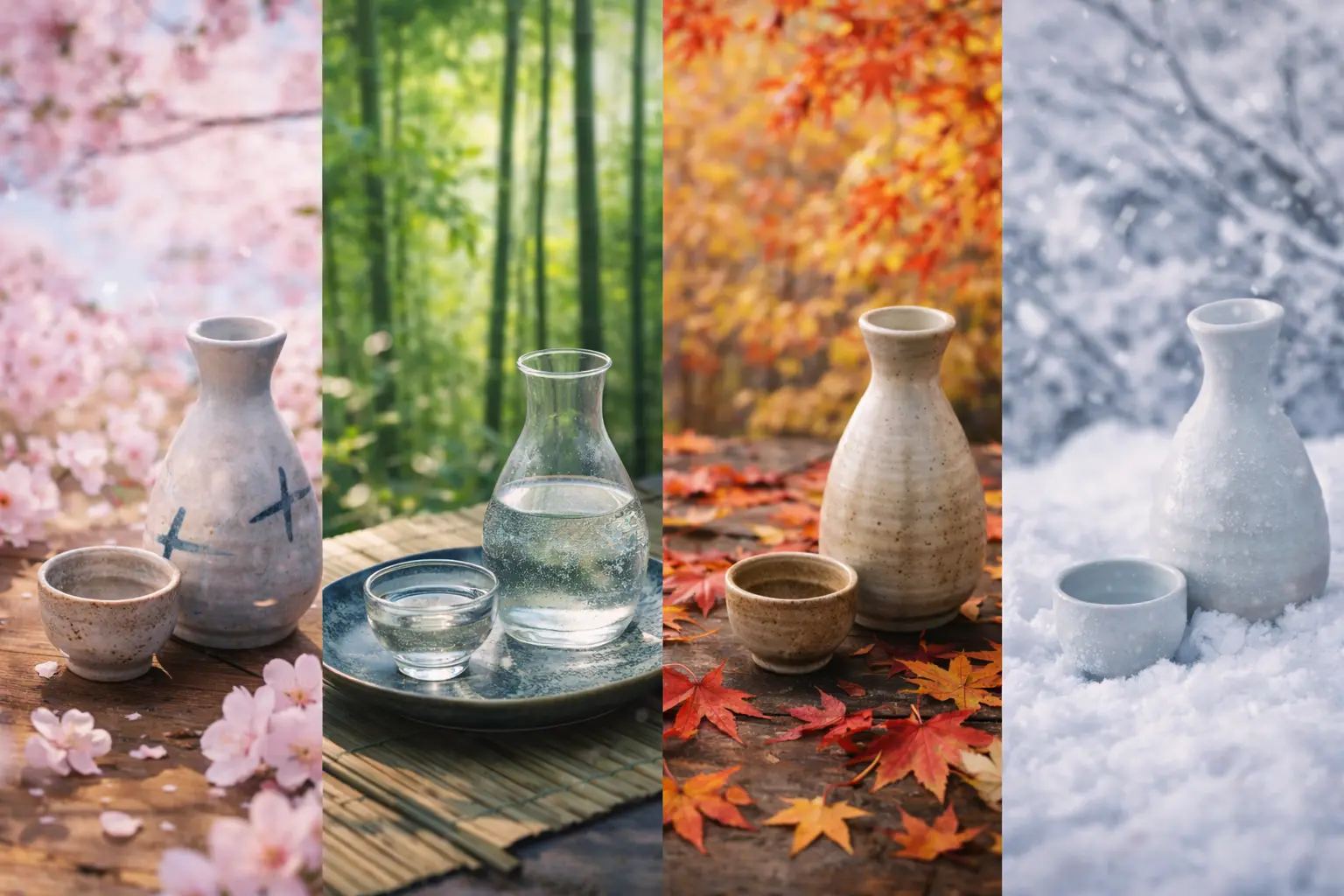
Enjoying Sake Through the Seasons
Sake keeps its own calendar. The Brewery Year begins in July, and October 1st — Sake Day — is a remnant of the old brewing new year. Here is how the brewery's annual cycle produces shiboritate, natsuzake and hiyaoroshi.
The Many Faces of Sake Across Four Seasons
Sake keeps a calendar of its own.
Just as wine has vintages, sake has its own annual boundary. Brewing follows that boundary, and sake with a different character ships out in each season. Once you know this calendar, the words on the shelves of a sake shop — shiboritate, natsuzake, hiyaoroshi — stop being mere product names and start reading as signs of where in the brewing process a bottle sits.
When Does the Sake Year Begin?
The sake world marks time by the Brewery Year (BY). Today it runs from July 1st through June 30th of the following year. When a label reads “Reiwa ○ BY,” it means the sake was made during that brewery year.
What makes this interesting is that the boundary used to fall elsewhere.
Under the Liquor Tax Law of Meiji 29 (1896), the brewery year was defined as running from October 1st through September 30th of the following year. Autumn — when the new rice comes in and brewing begins — was treated as the start of the year, a boundary that matched how brewers actually experienced their work. This was changed to the current July start by a National Tax Agency directive in the Showa 40 brewery year.
And here lies the reason October 1st is “Sake Day.” Established by the Japan Sake and Shochu Makers Association in 1978 (Showa 53), the date was chosen because it corresponds to what was once the brewing new year.
Incidentally, the element 酉 on the right side of the character 酒 (sake) is thought to have originated as a pictograph of a sake jar. That 酉 is also the tenth sign of the Chinese zodiac aligns neatly with the date October 1st.
Emotionally, at least, the sake year still begins in autumn.
A Year at the Brewery
The quickest way to understand the drinker’s sense of the seasons is to know the brewer’s year.
Autumn (September–October) — the new rice is harvested and the brewery comes to life. Milling and washing of rice begin, and preparations for the brewing season are made. People and noise return to a brewery that stood quiet all summer.
Winter (November–February) — the height of the brewing season. Sake is said to be made by kanzukuri (cold-season brewing) because low winter temperatures suppress unwanted microbes and allow slow, cool fermentation. For the toji and the brewery workers, this is the busiest stretch of the year.
Spring (March–April) — the year’s brewing comes to an end. Having finished the last batch, the brewery turns to cleaning up, and the long season of making closes.
Summer (May–August) — the season of storage and maturation. Pressed sake passes the summer in tanks, its edges softening as the flavor pulls together. For the brewery it is also a period for maintaining equipment and preparing for the year ahead.
This annual cycle is precisely what the seasonal releases look like from the outside.
The Drinker’s Four Seasons
Winter to Spring: Shiboritate and Shinshu
From around November, sake brewed with that year’s new rice begins to be pressed. This is what is called shiboritate, or shinshu (new sake).
Much of it ships unpasteurized, in its raw state, with a rough edge and a forward momentum. You may even sense a young, carbonated prickle. It sits at the opposite pole from the composure of matured sake — and it is a flavor you can meet only at this time of year.
This is also when a fresh sugidama (cedar ball), also known as a sakabayashi, is hung at the brewery. The bright green ball signals “the new sake is ready,” and as it browns and withers it marks the passing season in a way that mirrors the sake’s own maturation.
Spring: Haruzake and Cherry Blossoms
From March into April come the seasonal releases known as haruzake. Many are designed to look like spring as much as taste like it: pale pink labels, lightly cloudy usunigori styles, gently sparkling types.
If you are bringing a bottle to a hanami gathering, choose something light that drinks well chilled. Temperatures climb quickly outdoors, so bring a cooler. Low-alcohol and sparkling styles also suit an occasion that starts in the afternoon.
Summer: Natsuzake
Natsuzake is a category that has taken hold in recent years. Blue labels, clear bottles, cool-looking designs — the presentation is part of a product built for the hot season.
Inside the bottle you will typically find lower alcohol levels, pronounced acidity, nama-zake (unpasteurized sake), or sparkling styles. Serve them well chilled, or over ice. Summer has long been considered a difficult season for selling sake, but product development in this category is changing that.
Try a chilled junmai ginjo alongside summer ingredients — edamame, hiyayakko (chilled tofu), hamo (pike conger), ayu (sweetfish). Light sake is at its most useful precisely when the weather is hot.
Autumn: Hiyaoroshi and Akiagari
Autumn’s lead role belongs to hiyaoroshi.
Sake pressed in spring and pasteurized once is rested in tank through the summer, then shipped in autumn without a second pasteurization. This format is called namazume, and the “hiya” in the name comes from shipping — “oroshi” — the sake in its cool, ambient state.
Having passed through a summer, its edges have softened and its umami has come together. It has a settled quality that sits midway between the roughness of new sake and the complexity of long-aged sake. Akiagari is another term used in the same sense.
Ambient temperature to gently warmed nurukan is the easiest range to work with. Pair it with autumn ingredients — sanma (Pacific saury), mushrooms, satoimo (taro), chestnuts — and the season arrives at the table intact.
Winter: The Season of Warm Sake
Then comes winter, and warm sake takes its turn.
Junmai with substantial umami, and sake made by the kimoto or yamahai methods, come into their own when heated. Warm sake shared around a hot pot is an experience this season alone can offer.
At the same time, the new year’s shiboritate begins to appear, and the cycle comes full circle.
Following One Brewery Through the Year
The most straightforward way to enjoy the seasons is to follow the seasonal releases of a single brewery.
Drinking your way through shiboritate, then haruzake, then natsuzake, then hiyaoroshi from the same brewery and the same label reveals how each season is designed differently while the brewing character holds constant. The changes are far easier to grasp this way than by jumping between labels.
Learning when your sake shop rotates its seasonal stock lets you ride that year’s cycle. In many shops, the shelves are rearranged season by season.
Season, Temperature and Vessel
What conveys a season is not only what is in the bottle.
In summer, chill your glassware beforehand. In winter, warm a ceramic tokkuri and guinomi with hot water before use. Simply bringing the vessel to temperature first keeps the poured sake stable.
These gestures can look like mere formality, but they genuinely affect flavor. Pour cold sake into a chilled glass and the temperature holds; pour warm sake into a warmed vessel and it cools more slowly.
Seasonal sake is not a product of marketing. These are cases where the brewing process itself became the product name. Shiboritate is so called because it was just pressed; hiyaoroshi because one pasteurization was omitted.
Know the process, and you can infer what is in the bottle from the words on the label. Follow it across a full year, and the rhythm of sake brewing works its way into the drinker’s own life.
You begin to look forward, just a little, to what the next season’s shelf will hold.
For the difference between nama-zake and hiyaoroshi, see What Is Nama-zake.
For how temperature changes flavor, see Sake Serving Temperatures.
References: Gekkeikan, “The Brewery Year (BY) and Sake Day”; Japan Sake and Shochu Makers Association; National Tax Agency materials related to the Liquor Tax Law